Every poker player has bad habits. Some are small and barely dent your results. Others are silent bankroll killers, chewing through your win rate chip by chip.
Here are the five I see most often at the tables. Check them against your own game and count how many hit home.
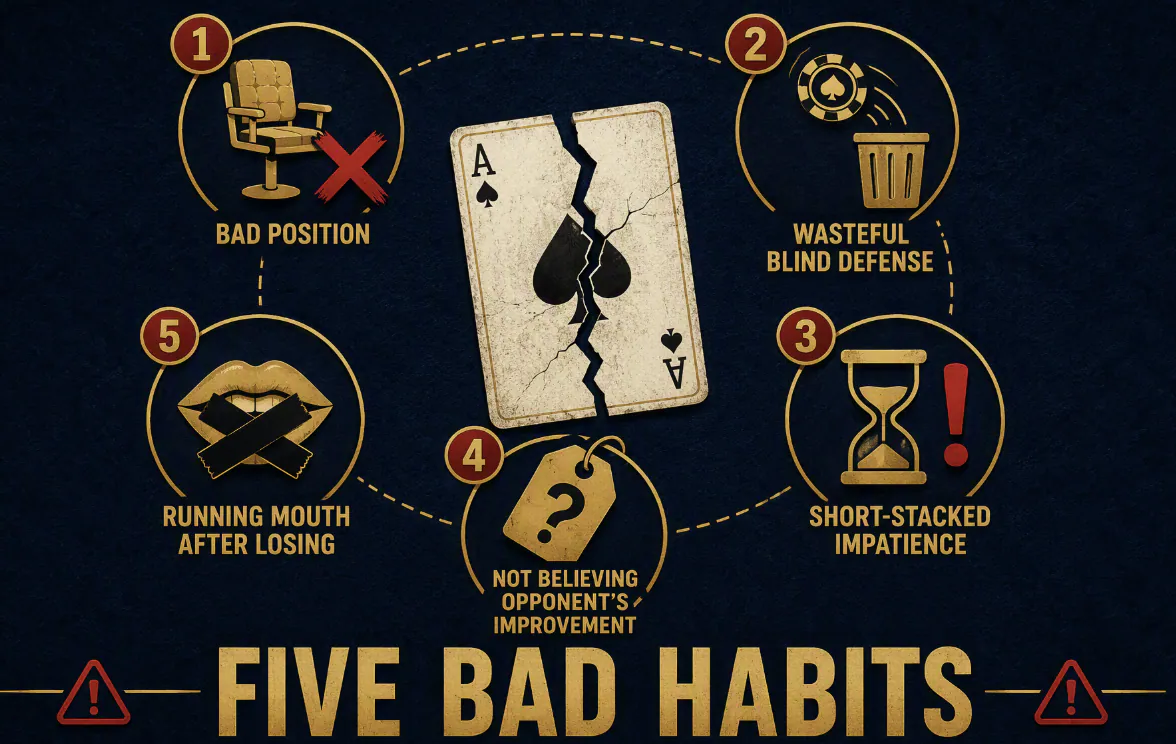
1. Playing Too Many Hands Out of Position
This is the big one.
Why do we do it? Plenty of reasons. Maybe you think your postflop game is so good that position doesn't matter. Maybe you have a "lucky hand" — it won you a huge pot once, and now you play it from every seat at the table.
But here's the cold truth: being out of position means acting first. You show your hand strength before your opponent shows theirs. That's a structural disadvantage, and no amount of skill plays your way around it.
Sure, some hands have to be played out of position. You're not folding aces under the gun. The real bleeding comes from the marginal hands. Play too many of them from early position and you're slowly hemorrhaging chips, session after session.
One line: position is poker's first law. When in doubt, fold. It's never wrong.
2. Defending Your Blind for the Wrong Reasons
The blinds are the worst seats at the table. You put money in before you even see your cards.
But here's the trap: because you've already thrown a chip in, you feel obligated to play. So you call with garbage and tell yourself you're "defending your blind."
That's the sunk cost fallacy, textbook edition. The money you put in is gone. It belongs to the pot now. Making a bad decision just because you already committed a small bet is one of the dumbest things you can do at a poker table.
Next time you're about to defend, stop and ask: is this a +EV play, or is my pride talking? If you can't give a solid answer, let it go.
One line: that blind is no longer yours. Don't let one chip hold your whole hand hostage.
3. Losing Patience When You're Short-Stacked
Short stack means aggressive. True. But aggressive doesn't mean desperate.
In tournaments, 20BB or less counts as short. When you're sitting on 15–20BB — especially while there's no ante — you usually have a couple of orbits of breathing room. Don't shove with any two cards just because your stack got low. Wait a few hands. Pick a spot. Find a hand that gives you a real chance.
I'm not saying wait for aces. That's fantasy land. But waiting two or three orbits for something clearly better than "any two"? That's just common sense.
One line: a short stack is a crisis, but it's also a weapon. Don't waste it on a coin flip.
4. Not Believing That Opponents Improve
Ever run into a player you used to crush a few months ago — and this time, you lost? First thought: "He got lucky."
Maybe. But here's another possibility you might not want to hear: he got better. And you? You're still playing him like he's the same fish. You didn't adjust. You lost, fair and square.
Smart players evolve. Yet a lot of us share one bad habit: once we tag someone — "nit," "fish," "maniac" — that tag never comes off.
Don't fall into that trap. At the start of every session, re-evaluate your opponents. Has he tightened up? Loosened up? Is he playing differently today? Build this habit, and you'll never be blindsided by somebody who quietly learned how to play.
One line: your opponents are upgrading. Your game needs to upgrade too.
5. Running Your Mouth After Losing a Hand
Are you the type who can't stop talking after a bad beat? "How could you call with that?" "You got so lucky." "I win that hand ninety-nine times out of a hundred."
If that sounds like you, stop. Every word you say at the table is free information for your opponents. They learn what tilts you and what breaks your focus. Next time they're in the same spot, they'll play the exact same way and take another bite out of you.
After a loss, shut up. Complain to your pillow. Vent to a friend away from the table. At the table, silence is your best defense.
One line: every word after a loss is ammunition for your opponents' next attack.
FAQ
Which of the five habits hurts your win rate the most?
The first one. Playing too many marginal hands out of position is long-term bleeding — the other four combined don't leak as much as it does.
Should a short stack ever shove any two cards?
No. At 15–20BB with no ante, you still have two or three orbits. Wait for a hand that gives you a real chance, then shove.
How should I vent after losing a big pot?
Silent at the table, loud off it. Complain to your pillow, rant to a friend later — just don't hand your opponents free information at the table.
Final Thoughts
None of these five habits look huge on their own. But they're like small holes in a bucket: each one leaks a little, and together they drain your bankroll faster than you'd ever guess.
Fixing bad habits is never easy. But poker is a game of edges — every leak you patch shows up directly in your results.
Next time you sit down, run through these five. Find the ones you brought with you. Spot them, watch them, fix them. Your bankroll will thank you.