Strong draws aren't as strong as you think. The 2-4 rule wildly overestimates once you pass 10 outs, your outs may be dirty, opponents may already have a full house, and even when you get there you can still lose to a redraw. Before you shove, ask three questions: what's my real equity, will he fold, and will he pay if I hit?
Two Hands First
Both of these hands are mine. Each one let me rethink the same question: is a strong draw really strong?
Hand One: 17 Outs, 23% Equity
1/3 game. I raise to $9 from early position. The cutoff calls, the button calls, the big blind calls.
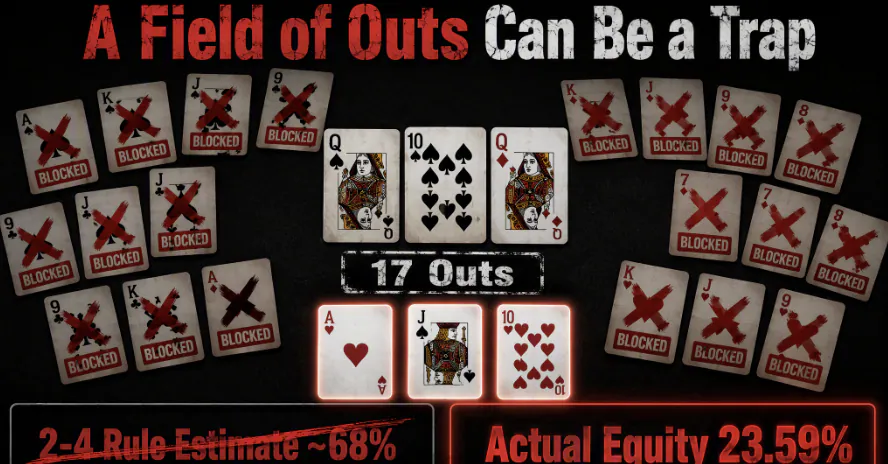
Flop: Q♠T♠Q♦. Two spades.
I bet 20. The cutoff calls. The button raises to $60. The big blind shoves 200.
I snap-fold.
The cutoff thinks forever, says "I just can't fold this," and calls. The button raises another 300. The cutoff calls again with a wry smile.
Turn and river are blanks.
Showdown: the button has AQ, trip queens. The big blind has Q9, also trip queens. The cutoff has K♦J♦ — a spade flush draw plus a gutshot, with straight flush possibilities on top.
The cutoff asks the table: "Who could fold this hand?"
The button grins: "Right? Flush draw, straight draw, maybe a straight flush draw. Who throws that away?"
I say: "I do. Because the board is paired."
Afterward I ran the numbers. The cutoff's "17 outs" KJ had an actual equity of 23.59%.
And note — that's with nobody already holding a full house. If someone had a boat, his equity drops even further.
Hand Two: 12 Outs, 32% Equity
$1/$3. It folds to me on the button with J♠4♠, and I raise to 12. The small blind — tight-aggressive, loves slow-playing — calls. The big blind, tight-passive, calls too. Effective stacks are 250.
Flop: 3♥6♣7♠.
I have a flush draw plus a gutshot. Twelve outs.
Small blind checks, big blind checks. I bet $18. The small blind folds. The big blind raises to $45. I call.
The turn is a blank. The big blind bets $200 straight out.
I fold. He shows 3♣3♦ — a set of threes.
A friend looks at my hand and says: "When he made it $45, you could have shoved! See both streets, realize all your equity!"
I told him: "That advice isn't dumb. It's malicious."
I ran the numbers afterward. My "12 outs" had an actual equity of 32.02%. Even with an open-ended straight draw (8 outs) it's only 38.48%. Swap my hand for A♠4♠ — flush draw plus gutshot plus an ace-high kicker — and it's still just 39.39%.
The big blind is tight-passive. When he raises, he is never folding. With no fold equity, shoving is just donating.
What These Two Hands Taught Me
At first glance, 12 or 17 outs looks like a field full of exits. In actual play, these "monster draws" are nowhere near as strong as the 2-4 rule claims.
Four reasons.
Reason one: the 2-4 rule breaks down past 10 outs. The more outs, the bigger the error. I've written a whole article on Solomon's correction that covers this in detail: Solomon's Rule Explained: With 9+ Outs, the Rule of 2 and 4 Needs a Discount . Short version: past 10 outs, the 2-4 rule inflates your equity and feeds you illusions.
Reason two: your outs are often dirty. In hand one, K♦J♦ looks like 17 outs, but the Q♠ is already in the button's hand — some of those outs are dead. More importantly, the board is paired: even when you hit your flush or straight, the opponent may already have a full house. The card you're chasing might not even win.
Reason three: even when you get there, the opponent has redraws. You make your flush, he still has boat outs. You make your straight, he still has flush or boat outs. Hitting your draw isn't the finish line. You still have to hold.
Reason four: a draw is a draw, and a made hand is a made hand. The plainest point, and the most ignored. The opponent already has trips; you're still chasing a flush. Until the turn and river are both out, your "maybe" never beats his "already."
So How Should You Play Them?
First, calculate real equity, not surface outs. Cut the dirty outs, factor in the opponent's possible boat outs, and recalculate with Solomon's correction. The number will sober you right up.
Second, calculate fold equity. If the opponent is tight-passive, once he raises there is no fold equity — don't bluff, and don't semi-bluff shove. Shove and he almost always calls, which means you're gambling on 30-some percent. That's -EV over time. If the opponent is loose-aggressive and can still fold after raising, your semi-bluff shove gains real extra value.
Third, calculate the payout. Say you hit on the turn — how much will he pay you on the river? Tight-passive players often run away faster after you hit than before. Hit and nobody pays, miss and you go broke. How is that a business?
My Personal Approach: Strong Draws and Sets in the Same Bucket
Last, my own method.
My strong draws with 10+ outs go into the same "range bucket" as my sets.
On the flop: whether it's a set or a monster draw, I bet small — a third or even a quarter of the pot. The goal is to probe, build the pot, and hide my real hand strength.
If I get raised: the picture clears up — he has something. I decide between calling and folding based on position and odds.
On the turn or river: if I get there, I bet two-thirds of the pot or even overbet, and take full value.
The beauty of this approach: opponents can't tell a set from a combo draw. First-time opponents see my small flop bet and figure I have nothing. When I suddenly come alive on the turn or river, they think I'm bluffing and call with top pair. By showdown, it's too late.
I've run this play countless times. It never gets old.
Wrapping Up
Strong draws aren't unplayable. They just have to be played correctly.
Don't let a number like "17 outs" go to your head. Those outs might be dead, might get outdrawn, and might pay you nothing even when they hit.
Before you decide whether to shove, ask yourself three questions:
What's my real equity? (Use the correction, not the 2-4 rule.)
Will the opponent fold? (No fold equity, no shove.)
Will he pay if I hit? (No payout, no chase.)
Think these three through, and strong draws are your weapon. Fail to, and they're your trap.
hope my article can help you.