The game today is nothing like it was ten years ago.
Even at the low stakes, you're surrounded by opponents who study poker seriously and show up with a clear profit goal. They watch training videos, run software, review every hand they play.
What does that mean for you? It means the same "standard lines" won't harvest them over and over anymore. They take notes on your sizing habits, your timing, how you react on certain boards — and then they feed all of it back into you.
So if you want to make money from good players, you have to do one thing: make sure they can never guess what you're about to turn over.
Here are the seven weapons I use to confuse good players. Every one of them has been battle-tested at the tables.
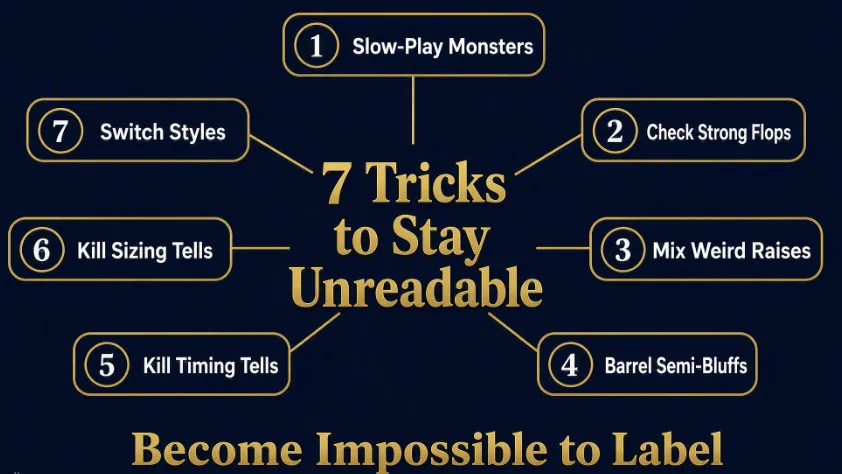
Tactic 1: Slow-Play Your Monsters Preflop Once in a While
Most people's standard line: pick up AA, KK, QQ or AK, raise preflop. Every time.
The problem is, once a good player confirms the equation "big hand = raise," your range gets squeezed into a very narrow box. When you raise, he folds his junk. When you flat, he plays against you with extra information. You lose both ways.
The fix: occasionally just call with those big hands.
This works even better in late position — the cutoff or the button. And here's a particularly juicy spot: when an aggressive good player is sitting in the blinds. You flat, he raises to "punish" you, you re-raise, and the pot balloons instantly — with his hand already crushed by yours.
You set the trap. He walked into it.
Tactic 2: Don't Bet Every Flop
A lot of players run on autopilot: flop top pair, bet. Always.
Good players love this type. You bet = you have it, you check = you don't. Crystal clear, zero difficulty to exploit.
The fix: check your strong hands on the flop once in a while.
Say you're holding K♣Q♠ and the flop comes Q♦6♣2♠ — top pair. You can absolutely check it. Next time the same spot comes up and you bet, your opponent has no idea whether you're for real.
The side benefit matters even more: when you check strong hands and weak hands alike, opponents stop stabbing at your checks — they're afraid you're trapping. That hands you a bonus weapon: your check-raise bluffs become credible even when you have nothing.
Tactic 3: Mix Some "Weird" Hands into Your Flop Raising Range
Low-stakes players usually raise flops with a very standard range: top pair or better, two pair, sets, and big draws with 12+ outs.
Too standard. A good player looks at your raise and locks you into the box of "monster or monster draw."
The fix: raise with two overcards sometimes. Raise with a gutshot sometimes. Raise with bottom pair sometimes.
You don't need much of it. As long as a small slice of your raising range is bluffs, the "never bluffs" label can't stick to you. Good players face a nasty dilemma against your raises: call and risk you're loaded, fold and risk you're bluffing.
And there's a hidden dividend: when you actually raise with the goods, they call more often — because you've already "proven" you're capable of bluffing.
Tactic 4: Blend Semi-Bluffs into Your Turn and River Barrels
Another spot good players have you pegged: your barreling range.
Most people only keep firing on the turn and river with strong hands — top pair or better, two pair, monster draws. Same old problem. Too readable.
The fix: keep barreling occasionally with two overcards, a gutshot, even bottom pair.
Same principle — you don't need a lot, a small slice does the job. Good players quickly notice "this guy fires turns without always having it." From then on, they can't comfortably call your value bets, because they can't tell the real ones from the fake ones.
Tactic 5: Kill the Timing Tell — Don't Let Your Speed Rat You Out
This is a detail, but to a good player, details are information.
Plenty of players bet instantly with junk or a mediocre draw, as if there's "nothing to think about." Then with a monster or a planned bluff, they take forever.
Good players catch that pattern. Fast bet = weak hand, long think = strong hand. Every second you hesitate, you're handing them information for free.
The fix: standardize your thinking time.
Whether you're bluffing with air, bluff-catching with middle pair, or closing the trap with the nuts — take the same amount of time to "think." Set yourself a three-second rhythm and silently count it out before every meaningful decision.
When your timing tells them nothing, your hand strength stays hidden.
Tactic 6: Kill the Sizing Tell — Don't Let Your Bet Size Rat You Out
This is one of the most overlooked and most lethal leaks in the game.
A lot of players unconsciously scale their bets to hand strength: big hand, big bet; weak hand, small bet. It's not deliberate. It's instinct.
Bad players never notice. Good players have it written down.
The fix: standardize your bet sizing.
If you've decided your c-bet is 60% pot, then fire 60% pot whether you're holding the top set, middle pair, or pure air. When your bet size reveals nothing about your hand strength, their "sizing read" goes dead.
One note for readers of my bet-sizing piece: that article was about picking sizes based on board texture and capped ranges — the theoretically optimal default. This one is about not leaking information to observant opponents. The two don't conflict. Learn the theoretical default first, then decide when hiding information matters more.
Tactic 7: Switch Styles Between Sessions Like a Chameleon
Good players keep files on your tendencies. Online it's even more brutal — they have HUD stats: your preflop raise percentage, your c-bet frequency, your fold-to-raise number... a string of digits and they've sketched your whole profile.
Once the label lands — "nit," "LAG," "calling station" — you're defined. And they know exactly how to beat what they've defined.
The fix: like a chameleon, switch styles from session to session.
Here's an example. A good regular sits next to you today, so this session you play wildly aggressive — constant raises, constant bluffs, pressure non-stop, until he's convinced "this guy is a maniac."
Next session, you're back to your normal game. But the "maniac" label is still fresh in his head, so he plays the anti-maniac strategy against you — while you've already switched gears, and he's a step behind everywhere.
You don't need to change every session. Once in a while is enough. The whole point is to make sure no fixed label ever sticks.
One Last Word
Good players aren't afraid of you playing well. They're afraid of not being able to read you.
If you're always predictable — raise the big hands, bet the top pairs, act instantly with draws — they'll eat you alive in comfort.
But once you learn to scramble your rhythms, mix in the unexpected, and hide your information, you stop being "an opponent who's easy to label" and become "a player who can't be defined."
Never let them guess what you're turning over next. That's the biggest headache you can give a good player.