A calling station's weakness is simple: they call too wide preflop and hate folding postflop. Beat them with four moves: size your bets so you never scare them off, fire with a wide range, respect their sudden raises, and value bet relentlessly thin on the river. Your profit doesn't come from one big extraction. It comes from collecting rent.
One Thing First
I tell people this all the time: develop your own approach. Don't copy someone else's game.
This matters most at small stakes, where your profit comes from exactly one source: your opponents' mistakes. If you just mechanically play ABC poker, you're competing with the fish for the same scraps, and nobody eats well.
Small-stakes players fall into four basic types. Calling stations, who call everything and can't fold. Under-reppers, who play weak whether they have it or not. Maniacs, whose thought process you'll never decode. And genuinely good players, who you need to handle carefully.
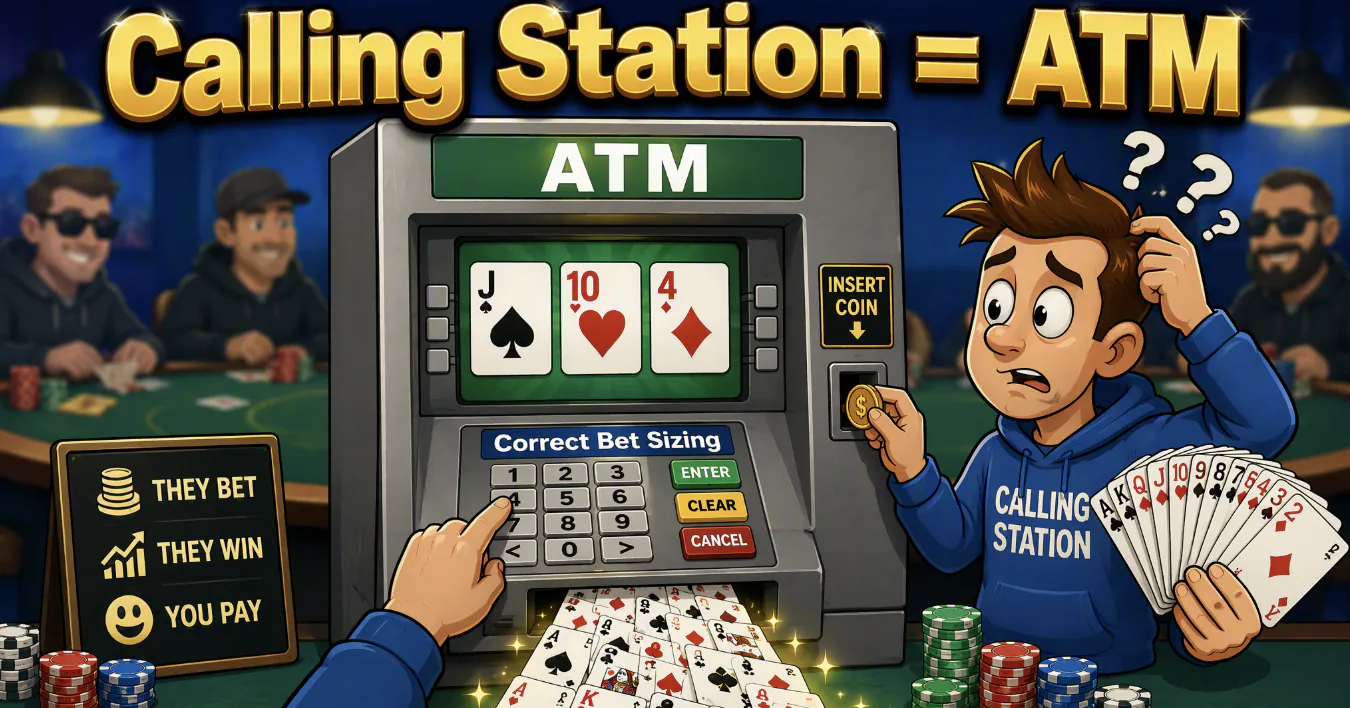
Today is about the first type. The calling station is the opponent you should be most grateful for, because they're the most reliable ATM at the table. With one condition: you have to know how to make a proper withdrawal.
1. Understand Who You're Dealing With
A calling station's profile fits in one sentence: calls wide preflop, folds rarely postflop.
They see flops with all kinds of junk. Hit something, anything, and they're going the distance. Miss completely, and they'll still peel one on the flop before giving up on the turn.
What does that make them? A person endlessly scratching lottery tickets. No win, toss it. Small win, cling to it for dear life.
Your job is simple: figure out what they've scratched this time, then collect at the right moment.
2. Bet Sizing Is Everything
Most players get this wrong against calling stations. The thinking goes: he calls everything, so I'll bet huge and he'll pay me off.
Wrong. Completely wrong.
Bet too big and you're forcing him into a correct decision: folding. What you want is for him to make an incorrect decision: chasing with odds that don't justify it. Make the chase too expensive and he stops chasing.
The effect you're after: give him a price that looks chaseable, so calling feels fine in the moment while quietly bleeding him over the long run.
So the core principle is one line: never scare him away, keep him calling. Your profit isn't one big extraction. It's rent, collected street after street.
3. A Real Hand
$1/$2 game. I open to $7 from middle position. The big blind, a calling station, calls.
Flop: J♠10♥4♦. He checks. My action.
First, what I would NOT bet here: hands like A9o, KJo, K9o. I don't play these in this spot. Why? The station calls me with all sorts of random trash, and my hand is stuck in no-man's land. Hit it and I can't extract big value; miss and I'm easily dominated. These hands are traps in games like this. Best not to play them.
What do I bet? Three groups.
Monsters: QJ, two pair, sets. Bet for value, always.
Every marginal hand: AJ, KJ, QJ, even A10. The station calls with gutshots and even ace-high, so my marginal hands are usually still ahead on this flop.
Draws: 98, Q9, KQ. Betting does two jobs — it builds a pot for when I get there, and it sets up turn pressure when I don't.
So my strategy against a calling station is this: continuation bet with a wide range, and keep his wider, weaker range permanently in the state of "I might be winning."
4. What If He Raises the Flop?
If the station check-raises me on the flop, unless I hold a monster (top two pair or better), I fold. Right away.
Why?
Experience says calling stations play straightforward poker. When they raise, they have something real: top pair or better, or a monster draw like an open-ender plus a flush draw.
A passive player who suddenly turns aggressive is the loudest alarm bell in poker. Don't argue with it. Don't argue with your own money.
5. The Turn: Keep Collecting Rent, Unless the Board Changes Everything
How do you play the turn? Start with one core question: what hands will he continue with?
Most calling stations continue with every ace-high, every gutshot, and every pair. So as long as my hand still has value, the turn is another bet.
When do I shut down? Two situations.
I'm holding AQ and the turn is an 8, making the board J-10-4-8. Too many straights got there. My AQ is almost certainly behind now.
I'm holding 55 and the turn brings an ace. My small pair is capped; any ace in his hand beats me.
Outside those two cases, my range usually still has 65% or better equity on the turn. An edge you don't use is an edge you wasted.
6. The River: Thin Value Is the Calling Station's Kryptonite
On the river, get one thing clear: which hands will he call with, and which will he fold?
The calling station's trademark: anything ace-high or better is a potential call.
What does that mean for you? Bet thin. You don't need a monster. Top pair or better is worth a bet, because the station will look you up with middle pair, bottom pair, even ace-high.
The exact size depends on how sticky this particular opponent is. The principle doesn't move: if you have a hand, bet it, and don't fear the fold. He folds far less often than you think.
The Four-Line Summary
Don't scare them off. Size your bets so calling feels cheap, while they bleed money the whole time.
Bet with a wide range. Monsters, marginal hands, draws all fire, because their range is wider and weaker.
A passive player raising is a danger signal. Respect it. Don't tough it out.
Bet thin on the river. Top pair or better is a bet. They'll call.
Calling stations don't show up to take your money. They show up to see cards. Let them see, comfortably, at a price they think is fair — and they'll hand you their stack, one curious call at a time.