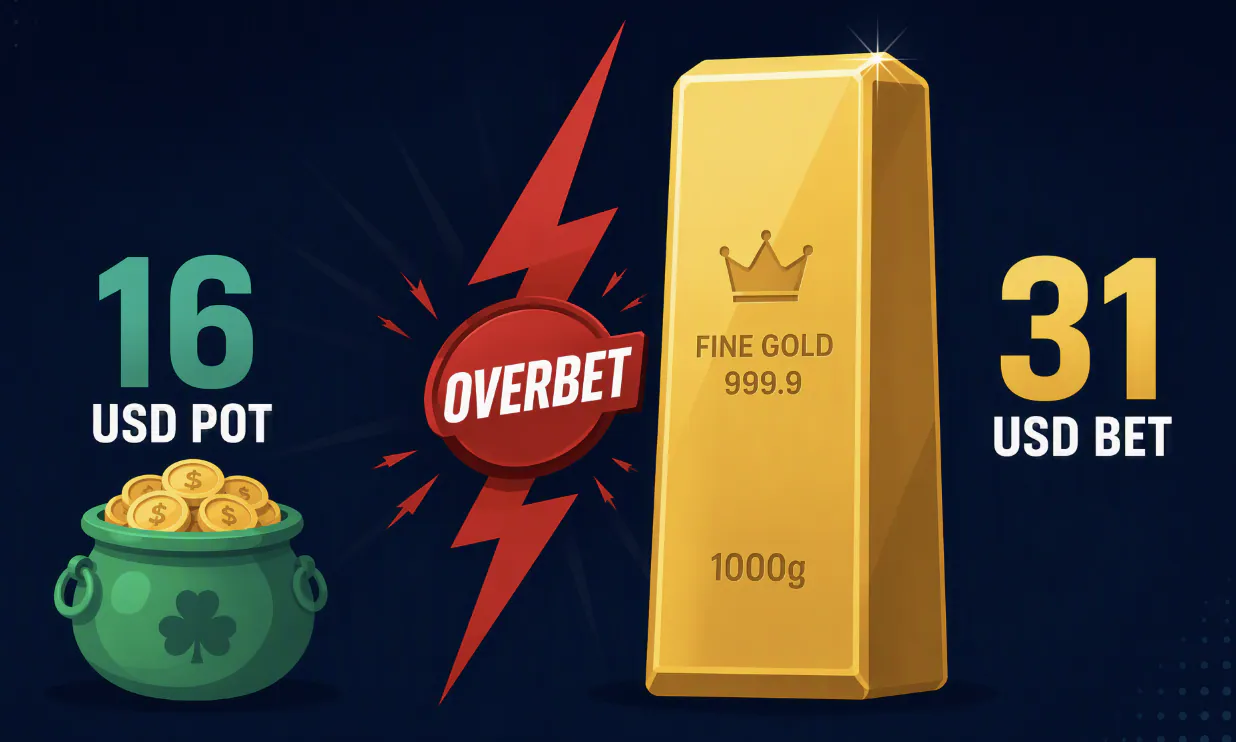
The river overbet is the most extreme pressure you can put on an opponent. A value overbet needs one of two things: his range is packed with second-best hands, or you've read him as someone who pays off big bets. A bluff overbet needs the opposite setup: almost zero showdown value of your own, plus cards that block the nuts. Bluffing $31 into a $16 pot has to work more than two-thirds of the time to profit, so make sure of your read before you fire.
The river overbet is the heaviest pressure move in the game. Let me break down a session I actually played, where I used it twice: once for value, once as a bluff. By the end you'll see exactly what each version is built on.
Two Reasons to Overbet for Value
The first is theoretical. When you hold a strong hand and your opponent's range is stuffed with second-best hands, a big value bet is the right idea. Picture a K-high flop where you hold bottom set and his range is full of Kx: the big bet is designed for those hands. Flip it around, hold KK on that same flop and a big bet can hardly get paid, because you've removed the Kx hands yourself.
The second reason is exploitative: you have a read that this opponent pays off big bets.
This next hand checks both boxes.
Hand One: J♣5♥ and the Three-Street Value Run
NL100 Zoom. I'm in the small blind with J♣5♥. Laugh if you want, this hand has been winning me big pots lately. It folds to me, and the big blind is a tight-weak player running a VPIP/RFR of 23/14, few hands, passive lines. Attacking the blinds is standard preflop strategy here, so I raise to $2.70.
The flop comes K♦5♠5♣, and the pot is $5.40. I continuation bet $1.59. The logic: a tight-weak player who missed this flop is basically never bluffing me, so a small bet does the job, and weak pairs plus ace-high can all call it. If he calls, the plan is to size up on the turn and target his Kx for value.
He calls. The turn is the 4♦, the pot is $8.54, and I overbet $11.
He snap-calls. That timing tells me everything. He's very unlikely to hold trip fives or a full house, and just as unlikely to hold anything weaker than top pair. Calling without a blink means folding and raising were never on his menu, so his range is locked on Kx.
What does that mean for the river? Unless the board changes violently, an ace or a diamond, he's never folding to a bet. Bluffing the river would be a terrible idea. Luckily, I'm holding the effective nuts, so when the 8♥ lands, my only decision is sizing.
The pot is $30.58. I choose to maximize EV and bet $34.
The overbet is theoretically optimal here because my hand doesn't block his Kx. It works in practice too, because his instant turn call told me he isn't folding.
He calls immediately and tables K♠Q♥. Pot shipped. His turn timing is what picked my river size.
Hand Two: J♣J♥ and the Bluff Overbet
Same session. I have J♣J♥ in the small blind. The UTG player, a decent regular, opens to $2.22, and the hijack, also a decent regular, 3-bets to $6.66.
I could 4-bet, but playing for stacks against these two positions feels awful, and my calling price is excellent, so I call. For whatever reason UTG folds, and I'm heads-up against the hijack.
The flop is A♠10♥8♣, pot $16.04. Terrible flop for JJ. My plan is to fold to a continuation bet from his strong range. He checks, I check back. His range at this point is unlikely to contain AK or TT, and looks more like AA, AQ, AJ, KK, QQ. My showdown value against that range is roughly zero.
The turn is the Q♣. I check again for free information. He probably avoids betting KK or weak Ax here, and if he does bet, his range is lopsided toward value like AA, QQ, AQ, and I plan to fold. He checks again.
The river is the 7♣, pot still $16.04. Inventory time: my two jacks neatly block K♣J♣ and J♣10♣, the nut straight combinations. And my chance of winning this pot by checking is basically zero.
His most likely hand right now is absolutely KK, with some Ax mixed in. Whether those hands fold to a normal bet, I'm not sure. Whether they fold to a big overbet, I'm close to certain.
Thinking exploitatively, I pick a size I would never use for value: $31. For this bet to profit, it has to work more than two-thirds of the time, because I'm risking $31 to win $16. I judge it works more often than that.
He folds instantly. A pair of jacks that was dead at showdown dragged the pot anyway. That's what resurrection feels like.
Two Overbets, Two Foundations

The river overbet is the heavy artillery in your arsenal. Used well, one hand can out-earn a whole session.
But artillery without a sight blows up on your own position. Theory gives you ranges and blockers, exploitation gives you reads and timing tells. Get both in place. Then pull the trigger.