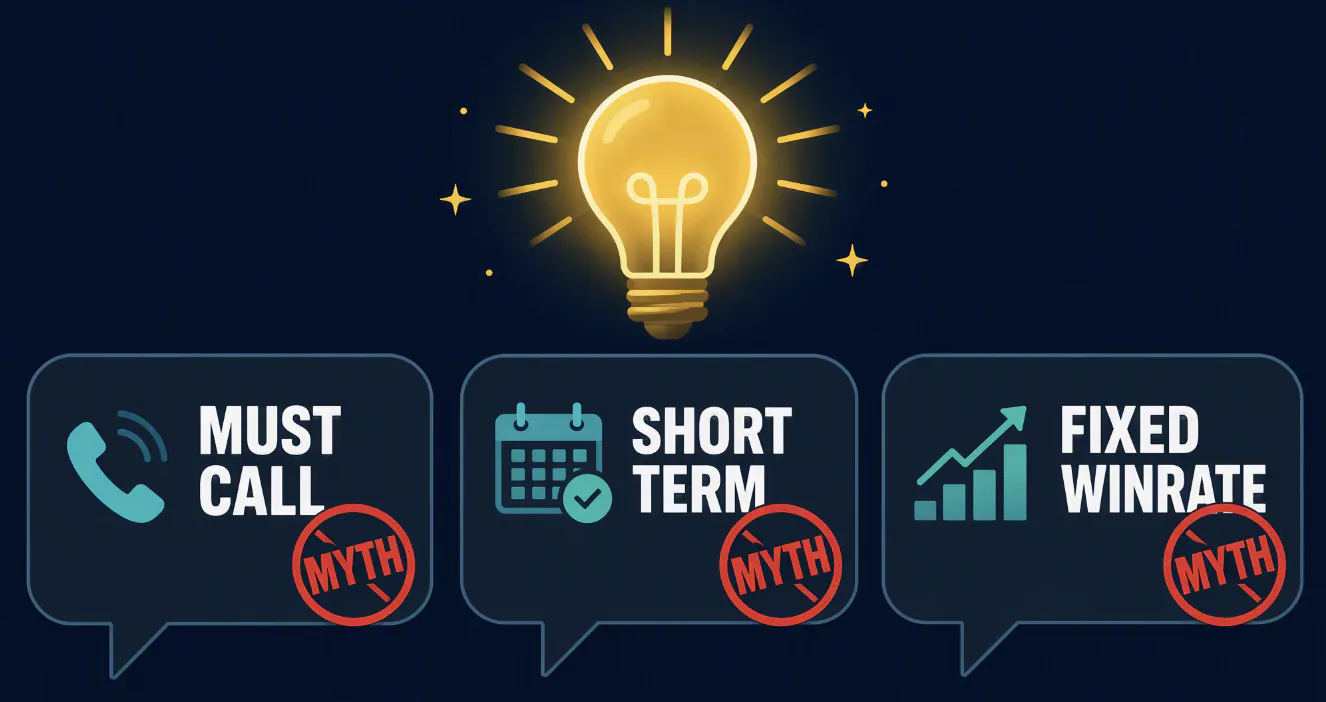
Great players and average players both make mistakes. The difference is why. For average players, emotion blocks good decisions, and emotion grows out of misunderstanding the game. The three most common myths: one, "you did X so you must do Y," when every street is actually an independent decision; two, reading short-term results as long-term trends, which is the disease behind downswing self-doubt and labeling a player after ten hands; three, believing your win rate is fixed and pays like a salary. Dodge these three and the quality of your decisions changes overnight.
Even the best players make mistakes.
What separates them is the reason behind the mistakes. For the average player, emotion is the roadblock to good decisions, and that's close to common knowledge. Put money in a game and people get emotionally invested, especially in a game this swingy.
Big variance scrambles short-term results, and short-term results lead people astray. You've seen it: a player goes all in with AK, runs into AA, and the next time he picks up AK his hands start shaking.
That's how wrong ideas quietly eat your win rate and twist your understanding of winning and losing. Here are the three most common myths. Don't let them stand in your way.
Myth One: "You Did X, So You Must Do Y"
Live poker is full of this advice. "You called preflop, so you have to call the flop." Or "you called the flop, and the turn is a brick, so you have to call again."
None of it has ever been proven, yet people repeat it like gospel.
The truth: every street is its own decision, judged on its own.
Let a tournament hand make it concrete. A player in middle position makes a small raise, the button calls, and you look down at 3♣4♣ in the big blind. The price is good, so you call.
The flop comes 10♣6♣6♥, about as friendly as it gets. You've got the flush draw. You check, the preflop raiser bets half pot, and suddenly the button makes a big raise.
Now ask the saying again: "you called preflop with 3♣4♣, so you should call when you flop the flush draw." Still sound right?
There are plenty of reasons to fold:
- The odds aren't there. Your hand can maybe call a half-pot bet, but a big raise? Not worth it.
- You're not closing the action. The preflop raiser still has a say, and if he raises again, you're driven off the hand.
- Someone may hold a bigger flush draw. A K♣Q♣ in either opponent's hand is devastation for you.
- You might even be drawing dead. If someone has pocket tens or pocket sixes, you're down to needing a backdoor straight flush, which is as close to dead as it gets.
- Notice something: none of these reasons touch the correctness of your preflop call. The price was good, so calling was right. Every decision in poker stands alone. Make the best play with the information you have right now, and you're playing your best.
Myth Two: Reading Short-Term Results as Long-Term Trends
Winning players lose too, sometimes for long stretches. That kind of adversity breeds self-doubt, and in a downswing some players slide toward despair until their normal level of play falls apart.
The fact is cold: what has already happened has no effect on what happens next. A winning player's job in a downswing is one thing only: keep grinding and wait for it to pass.
Easier said than done. Live poker makes it harder, because you play so few hands per hour that the psychological damage has time to warp your game before you can adjust.
Picture this. You're playing live and a new guy sits down on your left. Within ten hands, he has open-raised five times and 3-bet once. Most players instantly tag him as loose-aggressive, and maybe he is.
Then the chain reaction starts. His opponents attack him with stronger ranges, over-defend, adjust based on unreliable assumptions, and make mistakes because of it.
Making decisions on unreliable assumptions is the fastest way to go broke. The right move is to file the information away and adjust when the sample is actually there. Above all, don't make huge adjustments without solid information to back them.
Myth Three: Believing Your Win Rate Is Fixed
This one spreads fastest among cash game players, and it's the most dangerous of the three.
A player somehow computes his win rate, then assumes it will hold forever. He starts penciling in future income: this many hands, that many hours, this much money by then.
What makes this scary is that he genuinely comes to believe poker pays a stable salary.
A professional's real life looks different: long heaters and long downswings are both normal, which makes predicting any given month's income basically impossible. Tournament players feel it hardest, because the payout structure means going months with nothing to show is a normal plot line, not a crisis.
The other side of the coin deserves care too: a weak player on a short-term heater will overestimate himself just as badly.
Bottom line: before you start computing your income, you need tens of thousands of games behind you. Below that sample, every conclusion is a mirage.
FAQ
If my preflop call was wrong, should I fold fast on the flop to stop the bleeding?
Judge every street on its own. Whether preflop was right or wrong has no bearing on the flop decision, which depends only on the current odds and information.
What should I actually do during a downswing?
Keep grinding and wait for it to pass. Money already lost has no influence on future hands. The only thing you control is the quality of each decision.
How big a sample before my win rate means anything?
Tens of thousands of games. A few months of results say nothing. Pricing yourself off short-term results makes you arrogant when you win and destroys you when you lose. Both directions are traps.
Final Thoughts
The three myths are really one thread: never let emotion and illusion make your decisions.
Score every street on its own, don't treat the short term as the trend, and don't expect your win rate to pay like a paycheck. Weld those three rules into your head, and the reasons behind your mistakes will start looking a lot like a great player's.