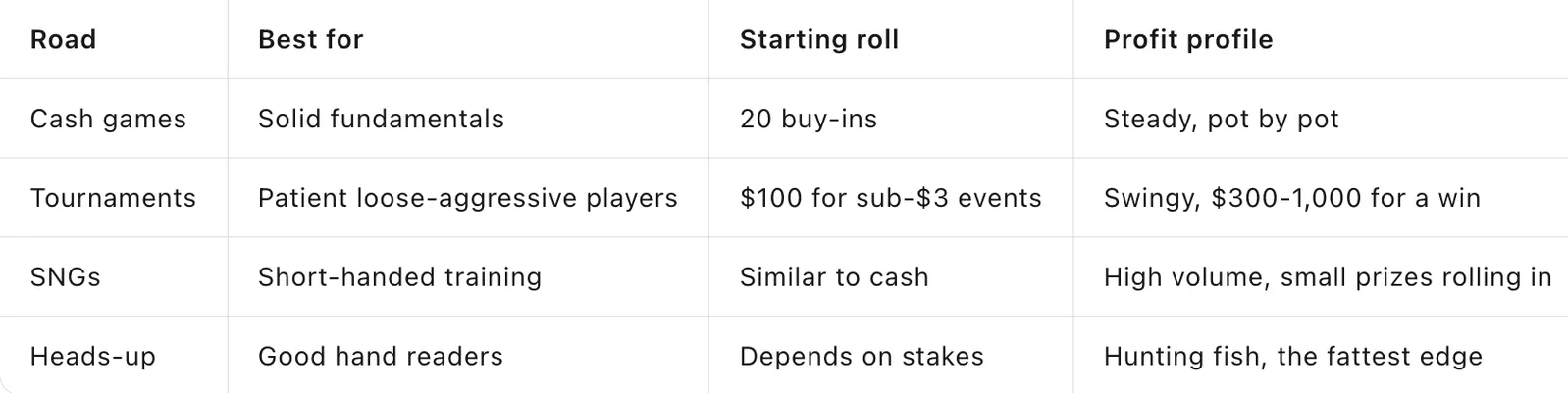
There are four main roads to beating the small stakes. Cash games: play the lowest stakes, follow Jonathan Little's five tips, and move up once you've won 20 buy-ins. Tournaments: play loose-aggressive, enter big online events under $3, where first place pays $300 to $1,000. SNGs: build your roll and your short-handed skills at the same time. Heads-up: find the fish, sit on his left, or isolate him every chance you get.

Profit at the small stakes isn't just about building a bankroll for higher levels. It matters because winning hand after hand proves your ability to yourself. That's where confidence comes from.
Where do you start? Four roads. Let's walk them one by one.
Road One: Cash Games, Starting From the Bottom
Coach Jonathan Little has five tips for crushing the small stakes. Here's each one, unpacked.
1. Stop calling preflop raises with junk
You don't need to play every pot, even if you're sure your postflop edge is real. Play fewer hands, and win as many of the pots you enter as possible. Plain English: play tight and pick quality starting hands.
2. Stop defending the small blind
When someone raises, fold most of your hands in the small blind. No position means no edge, and in multiway pots it's a disaster. The data is in: players who habitually defend the small blind are long-term losers there. Cut your small blind entries and check your results in a month.
3. 3-bet more often
Only 3-bet the nuts and your opponents will figure you out fast, and your 3-bets stop getting paid. Widen the range. Against a calling station, 3-bet premiums only and don't poke him with the rest. Against someone who folds to 3-bets a lot, go mixed range: premiums plus hands that can't call.
4. Fight back against c-bets
Everyone fires continuation bets now, because too many players fold at the first sign of pressure. Don't be that soft target, especially heads-up. Any pair, any flush draw, straight draw, or backdoor draw is good enough to continue. Opponent c-betting way too much? Raising is the best answer.
5. Value bet the river more often
A lot of players carry a fixed idea: a river bet is either a monster or pure air. That idea drives them to find reasons to hero-call, as long as your bet isn't huge. So when you look ahead, even without the nuts, bet. Give them a fair price to call and let them pay to catch you.
Bankroll: 20 Buy-ins and You Move Up
Skill alone won't get you there. Bankroll management comes first.
The rule is one line: win 20 buy-ins at your current level, then move up. Playing NL2, the $2 buy-in tables, you move to NL5 once your roll grows by $40, then to NL10 once it grows another $100. Clear target, clear path, and your first $1,000 is closer than you think.
Road Two: Loose-Aggressive Micro Tournaments
The second road to a fast bankroll is building a big stack with loose-aggressive play in tournaments.
Here's how: enter lots of pots in position; raise and re-raise more often preflop and on the flop with weak hands; float opponents when you have position and take the pot away on later streets.
Most players in micro tournaments play too tight. They wait for a big hand, play one big pot, then wait for the next one. While they wait, the blinds chew them into a short stack, they lose one coin flip, and they're left wondering: I didn't make a single mistake, so why can't I ever win a tournament?
That pattern is still everywhere today. My advice: play big-field online tournaments with buy-ins under $3. Even a $100 bankroll gives you plenty of bullets. Winners of these events usually take home $300 to $1,000, sometimes more.
Road Three: Micro Stakes SNGs
If you like tournaments, someone's probably pitched you SNGs, the sit-and-go. Fields run from 3 to 180 players, with 6-max and 9-max the most common.
A big tournament sacrifices the many to crown the top three, with most of the prize pool locked up at the final table. An SNG is a mini tournament with a similar structure, and it's the best training ground for short-handed play. Win SNGs regularly and your roll grows fast.
Players at micro SNGs are generally weak, and their leaks are remarkably consistent: too passive, no understanding of position, no clue about value betting, random starting hands, chasing hopeless draws, and calling down with any pair. Every beginner mistake in the book, all in one seat.
Stringing together a few wins in these games isn't hard. Once the roll is built, climb the levels with the same 20 buy-in rule, and the first $1,000 takes care of itself.
Road Four: Heads-Up, and Hunt the Fish
The greatest players in the world are all strong heads-up players, because heads-up is that profitable.
The idea is simple: track the fish and play them heads-up, so you get to play every single hand against them. Plenty of players want the same seat, so be patient.
Experience says this: look for 6-max or 9-max tables with only two or three players seated. There's usually a fish at one of them. Watch first. Fish are easy to spot: they limp into pots, they call too much, and they never fold top pair.
Once you've marked your target, grab the seat on his immediate left. Can't get it? No problem. Isolate him preflop and manufacture heads-up pots against him anyway.
Which Road Is Yours
The small stakes aren't a sandbox for beginners. They're an ATM, if you follow the rules: tight starting hands, rarely defend the blinds, 3-bet with courage, fight back, and take value on the river.
Pick your road, win your 20 buy-ins, and move up. See you at the next level.