You check medium hands on the river because betting gets nothing done: worse hands won't call, better hands won't fold, so the bet is neither value nor bluff. But the rule isn't set in stone. If a bet folds out enough hands to push the bluff's EV above the check's EV, bet even with a hand that often wins at showdown. Checking is worth 30, bluffing is worth 40, and that 10-point gap is pure profit.

Most players learned the standard river script long ago: value bet your good hands, check your medium hands, bluff occasionally with your bad ones.
Betting good hands makes sense. Bluffing bad hands once in a while makes sense. But why do medium hands have to check? Figure that layer out, and your river play finally graduates from beginner level.
Medium Hands Check Because They're Stuck in the Middle
Medium hands live in an awkward spot: they can win at showdown, but a bet gets no respect.
They're strong enough to beat plenty of hands at showdown, yet not strong enough to make a bet work. Worse hands won't call it, better hands won't fold to it. Fire the bet and you've achieved nothing: it's not a value bet, and it's not a bluff either.
So checking is the best line. You collect your showdown value for free.
A Limit Hold'em Example: AK That Went Nowhere
You hold A♣K♠ on a board of Q♥-8♣-7♣-2♠-2♦. By the river your AK never improved; it's ace-high. The pot already holds 8 bets, and your opponent checks. Your hand is the textbook medium hand.
You bet one bet. He has to call one bet to win nine, so he's getting 9:1 on the call.
His response is easy to map. With a pair, he probably calls. Without one, he can't. Fringe cases exist: he might fold a baby pair like 44, or call with ace-high and a big kicker like AJ, but those are outliers, not the norm.
The norm: when called, you usually lose; him folding a hand better than AK almost never happens. The bet accomplishes no bluff and claims no value. Checking is the best play.
One technical note: if both purposes, bluffing and value, have a real chance of working, betting is still good. These "two-way bets" come up in no-limit too, just with far more moving parts to account for.
The Rule Is Fine. Don't Tattoo It on Your Brain.
Plenty of players swallow the whole framework: bet the good, check the medium, bluff the bad once in a while.
In limit hold'em you'll rarely go far wrong playing that way. In no-limit, be careful, because the borders between good, medium, and bad get blurry. What looks medium to you might look strong to him, and the hand you're sure wins at showdown might be exactly the right bluff candidate.
The Twist: Medium Hands That Win at Showdown Sometimes Make the Best Bluffs
Do the math with me.
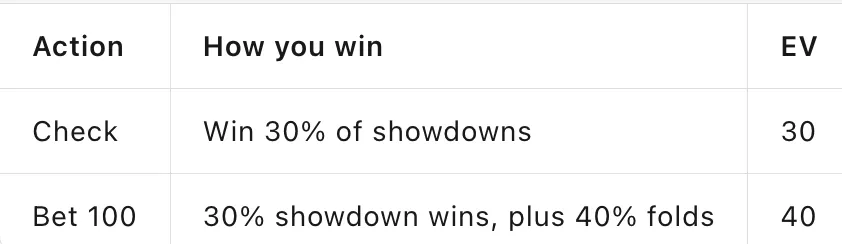
The pot is 100 and you're last to act. Your opponent checks. If you check behind, you win the showdown 30% of the time. The EV of checking is 30, that's 100 times 30%.
If you bet 100 as a bluff, you win 70% of the time. That 70% breaks down like this: the 30% you were already winning at showdown, plus another 40% where he folds. The hands he folds aren't trash, they're just not strong. In real games, think top pair with a medium kicker.
The EV of the bet: 70% of the time you win 100, and 30% of the time you lose the 100 you bet.
40 = 0.7 × 100 − 0.3 × 100
Checking is worth 30. Bluffing is worth 40. Even though this hand wins at showdown plenty often, the extra 40% of folds buys you 10 points of pure profit.
Bet the good, check the medium, bluff the bad" is a fine starting point. It was never meant to be the finish line.
Every river decision lands on the same arithmetic: what is checking worth, what is betting worth, and which number is bigger. The rule of thumb gets you in the door. EV gets you the money.