You know the spot. You're sitting on a draw, someone bets, and you've got seconds to decide if continuing is worth it. Step one is knowing how often your hand actually gets there.
Most players reach for the Rule of 2 and 4 to answer that. It works fine when outs are few. Once the outs pile up, it starts lying to you. Solomon's Rule is the patch.
First, Count Your Outs
Outs are the cards left in the deck that complete your hand.
Take a flush draw. Two suited cards in your hand, two more of that suit on the flop. A suit has 13 cards total, minus the two in your hand, minus the two on the board. 13 − 2 − 2 leaves 9. You have 9 outs.
The Rule of 2 and 4, and Where It Goes Blind
The Rule of 2 and 4 is a shortcut: multiply your outs by 2 with one street to come, by 4 with two streets. That gives you the percentage.
Flopping a flush draw with two streets to come means 9 times 4, so 36%.
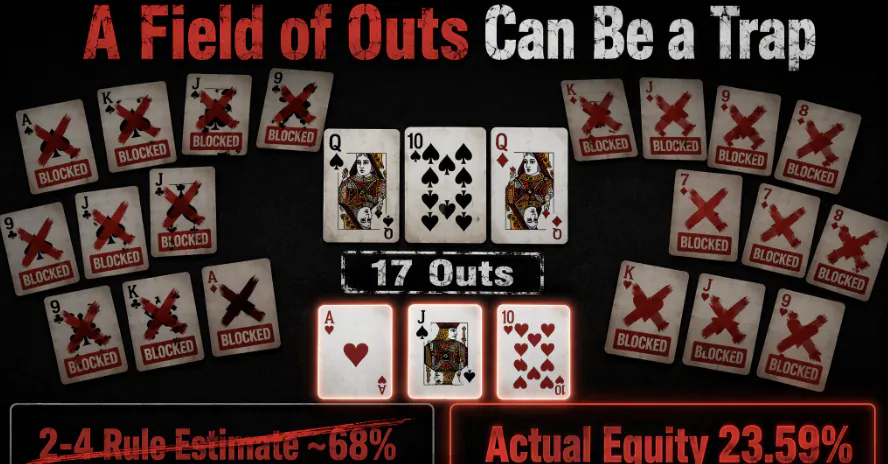
The trouble starts when outs get big. The shortcut approximates each street independently, and as outs climb, its estimate drifts above the true probability. The stronger the draw, the hotter the inflation. With a monster 15-out draw, the Rule of 2 and 4 overstates your equity by almost 7 full points. At the table, 7 points is more than enough to dress up a bad call as a reasonable one.
Solomon's Rule: Add One Correction Term
The rule itself is simple. With one street to come, it matches the Rule of 2 and 4 exactly, no adjustment. With two streets and 9 or more outs, subtract one correction term from the old formula:
Equity ≈ (X×4 − (X−8))%, which simplifies to (3X+8)%
X is your outs. Below 9 outs, just multiply by 4 and leave it alone.
Two Examples, Watch the Gap
Back to the flopped flush draw with 9 outs. The Rule of 2 and 4 says 9 times 4, so 36%. Solomon's Rule says 9×4 − (9−8), which is 35%. One point apart. No harm done.
Now the open-ended straight flush draw: both ends of the straight plus the flush, 15 outs. The Rule of 2 and 4 hands you 15 times 4, a scary-solid 60%. Solomon's Rule gives 15×4 − (15−8), which is 53%. The gap blows open to 7 points.
Who's right? Ask the exact math. The true probability of hitting at least once across two streets with 15 outs is about 54.1%. Solomon's 53% hugs it, while the Rule of 2 and 4's 60% is off in the clouds.
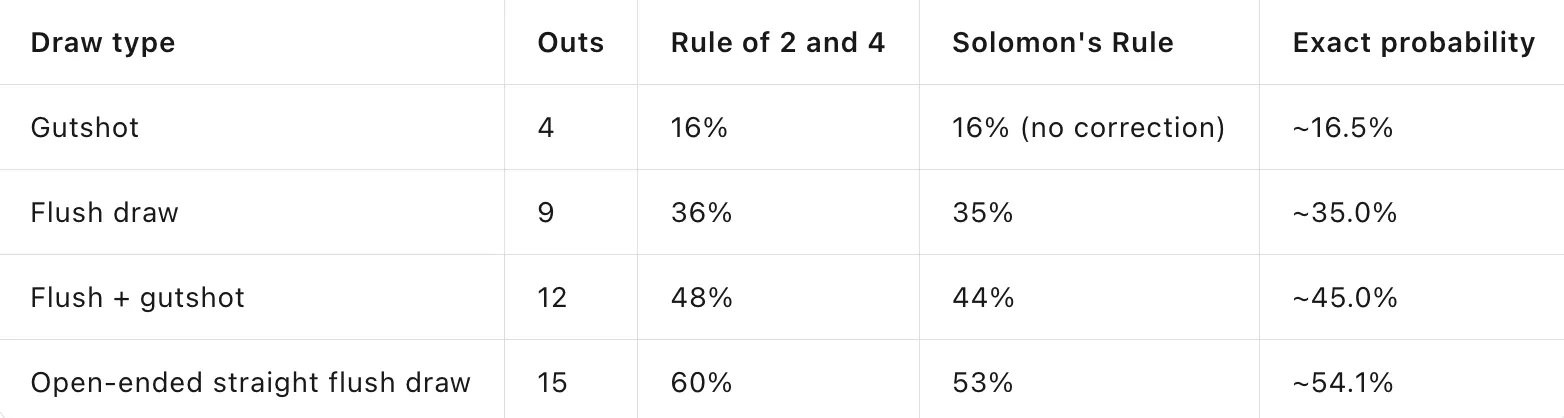
The pattern is right there: the fewer the outs, the tighter the two formulas agree; the more the outs, the bigger the Rule of 2 and 4 brags, while Solomon's Rule keeps its feet on the real numbers.
Mental Math at the Table
One line does it: multiply your outs by 4, then subtract outs minus 8.
Fifteen outs: 60 − 7 = 53%. Twelve outs: 48 − 4 = 44%. Ten seconds, faster than any calculator app, and sharper than the old shortcut.
the Rule of 2 and 4 is built for speed. Solomon's Rule is built for accuracy. With a small draw, use either. With a big one, don't let a phantom 60% make your call for you.
Next time you're holding a monster draw and itching to pile chips in, take three seconds and subtract that correction term. Get the number right first. Then play.