n life and at work, we all want every investment to pay us back. That number, what you get back on average over the long run, is expected value. In poker we just call it EV.
Every action in poker carries an EV. Calling has one, raising has one, folding has one too. Positive EV means the action earns you money over time. Negative EV means it leaks. So every decision at the table really comes down to one sentence: pick the higher EV.
Start With a Coin Flip
I flip a coin, you guess heads or tails. Every guess costs you 1 yuan. Guess right and I pay you 1.5, guess wrong and your 1 yuan is mine. Do you play?
For entertainment, maybe, losing a little is fine. But say you're here to make money. Then you refuse, and the reason is that your expected value is too low.
Run the numbers. You win 50% of the time, and a win nets you 1.5 minus 1, so 0.5 yuan. Averaged out, that's 0.25 yuan won. You lose the other 50%, and a loss costs you 1 yuan, which averages to 0.5 yuan lost.
EV = 50% × 0.5 − 50% × 1 = −0.25
Every round you play costs you 0.25 yuan on average. The more you play, the more you lose, so refusing is right.
Now a Real Hand
You hold A♠2♠, and on the turn the board reads 6♠ K♠ 9♥ 3♦. You've got the nut flush draw and there are 50 chips in the pot.
Across from you sits a tight player. The problem: you have only 20 chips left while he's deep. He bets 20, which means calling puts you all in. Judging by how he plays, you're pretty sure he has the goods, at least two pair, maybe a set.
You get two options: call or fold. Which one?
Honestly, the hand is out of your hands now. A spade on the river and you win, anything else and you lose. So the job is to compute the EV of each option and take the higher one.
Work Through Both Options
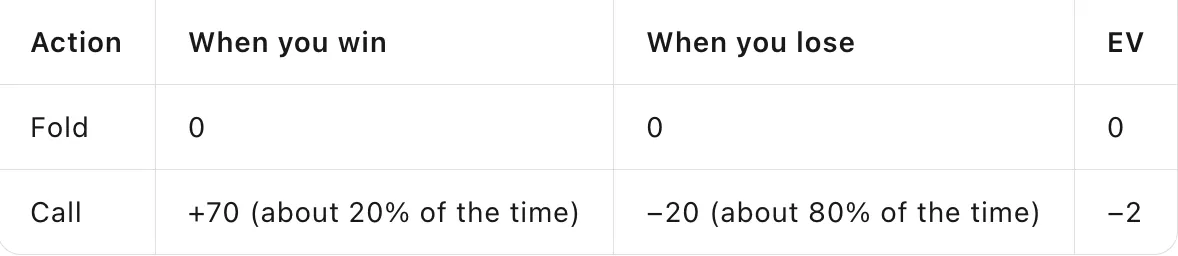
Folding: EV = 0
Fold and you neither gain nor lose. EV is 0. That's your baseline.
Calling: Get the Equity First
There are 13 spades in the deck. Two are in your hand, two are on the board, so 4 are accounted for. Out of 52 cards you've seen 6, leaving 46 unknown. Of those, 9 are spades and 37 are everything else.
A spade on the river comes 9/46 of the time, that's 19.6%. No spade is 37/46, or 80.4%. At the table, rounding to 20% and 80% is fine. Estimates like this land on the same answer as the exact math.
Calling: Now the Money
When you win, you collect 70 chips: the 50 in the pot plus the 20 he just bet. That's 20% times 70, an average of 14 won.
When you lose, you lose your 20-chip call. That's 80% times 20, an average of 16 lost.
EV = 14 − 16 = −2
Every time you make this call, you lose 2 chips on average.
So, Call or Fold?
Calling loses 2 chips a pop, folding loses nothing. The answer is fold.
It might feel wrong, since you're holding the nut flush draw. But the math doesn't care what draw you're holding. It only counts outs and bet size. Nine outs and 19.6% equity can't carry a 20-chip all-in.
Folding won't win you money, but it loses you less. Burn this into your head: winning fewer chips is the same as losing chips, and losing fewer chips is the same as winning.
Simple spots can be computed exactly like we just did, and strong players run it in their heads in seconds. Complicated spots resist clean math, so you estimate. Get a rough number, choose the line with the higher EV, and over time the money ends up on your side.
EV isn't some advanced theory. It's one line of arithmetic: probability times payoff, added up and compared.
Next time you face an all-in, don't ask yourself "can I really let this draw go?" Ask "what's the EV of this move?" Make that question a habit, and you stop being a gambler and start being a businessman.