Anyone who's been playing for a while will agree on how much bankroll management matters. We never play at stakes our bankroll can't cover.
Think about the logic of the table itself. Everything you do is about making your own decisions easier and your opponent's decisions harder. A player with sloppy bankroll management has shoved himself into the hard seat before he even sits down.
Golden Rule One: Sit Down With at Least 75-100BB
In any given session, you can go a long stretch without a decent hand. That's normal, and you should expect it.
A short stack creates two problems. You can't play the speculative hands, because they need a deep effective stack behind them to be worth anything. And the other side hurts even more: when the big hand finally shows up, you can't win enough, because there's only so much in front of you.
So 75BB is the floor when you take a seat. 100BB is comfortable.
Golden Rule Two: One Table Holds at Most 5-10% of Your Bankroll
This rule keeps you at 10 to 20 buy-ins at all times. Even through a brutal stretch of losing, going broke stays off the menu.
If you're the extremely cautious type, push the number lower. Some pros run on 2%, which means 50 buy-ins as the baseline.
Whether you pick 5% or 10% comes down to your financial situation. If you have other income propping up the roll and the poker money isn't a real risk to your overall finances, you can handle bigger swings and 10% works. For most people, I recommend 5%. It's a reasonable cushion, and you won't get broken easily.
Do the Math: What a $0.25/$0.50 Table Demands
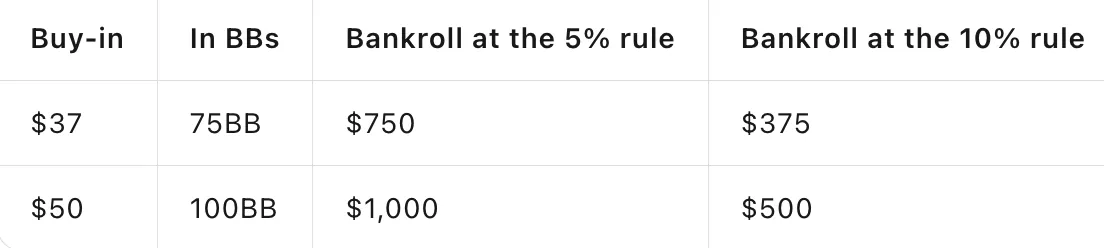
That's a wide spread, from $375 to $1,000. Where you land depends on how thick a safety net you want behind you.
My advice goes like this. At the lowest stakes you can accept more variance, so 10% is fine. Once you move up, squeeze that number down to 5% or even less. The higher the stakes, the tougher the opponents, the longer the downswings, and the thicker your cushion needs to be.
Why Bankroll Management Keeps You Alive
Your skill doesn't matter here, and neither does how clever your new strategy is. Poker is a probability game.
You can put yourself on the right side of the odds every single time, and you should always be hunting for those spots, but some of those hands you still lose. Sometimes the pot that goes against you is huge, and a whole buy-in vanishes just like that.
The 5-10% rule exists for exactly that day. When the bad beats come in bunches and the luck turns rotten, you're still holding another 10 to 20 buy-ins to grind the losses back.
Follow these two rules and going broke stays far away, unless you run into a genuinely monstrous downswing or you're flat-out playing badly.
When the Money Moves, Your Stake Moves With It
Your bankroll is a living number, so your stake has to be one too.
Lose for a stretch and watch the roll slide, then drop down in stakes. Stay there until the money can cover your regular level again, then come back. That's not shameful. That's the rule.
On the other side, keep winning and the roll keeps climbing, and it's time to think about moving up. Move to a level you can actually beat. Don't leap.
Take a $1,000 bankroll challenge as the picture: start at the low stakes, build the roll, step up to mid stakes, then push toward the higher ones. The whole way through, no single session gets more than 10% of the total. When the challenge moves into its next stage, cut that 10% down to 5%. Your bust risk drops another notch, and the bankroll gives you real peace of mind.
Learn the two rules and follow them. Skip them, and going broke is easy.
You can't control what cards come off the deck. You can absolutely control how much you sit with and which table you choose.
75-100BB is your ammunition. 5-10% is your lifeline. Let the bankroll decide your stake, not your ego.
Take care of the money, and the game takes care of itself.