Everyone at the table has heard the word "blocker." Far fewer can tell you what it actually does for them once the cards are in the air.
It comes down to one thing: the cards you're holding reduce the combinations your opponent can have. There are four queens in the deck and you're sitting on two of them, so half his possible queen combos are gone. Once you know what he can hardly have, you get a much firmer read on whether his bet is for value or a bluff.
Here are the four spots where blockers earn their keep.
Spot One: Top Set, Raise or Slow Play?
Online 6-max. A player in middle position opens, and we call from the big blind with QQ to mix things up. Heads-up pot.
The flop comes Q-x-x, dry and rainbow. We flop top set and check. He fires a standard continuation bet. Raise or not?
Against a calling station who never folds, sure, raise away. But what if you know nothing about the guy?
This is where beginners get carried away dreaming about maximum value. Slow down and ask the real question: what hands can he comfortably call with? Mostly top pair combos. Except you hold two of the queens and the third is sitting on the board. The combos he can call with are cut to a fraction, so if you raise here, he's folding most of the time.
That's why slow playing is almost always the right move on a safe, dry flop like this. The blocker tells you his range is too thin to push against. Let him walk into the trap on his own.
Spot Two: Picking Your 4-Bet Bluffs
Against an aggressive player's 3-bet, we defend by calling and re-raising. Blockers hand you the answer to which hands make the best 4-bet bluffs, and your success rate goes up with it.
Same logic as before: if we 4-bet, what does he continue with? Some players will call a 4-bet with pretty hands like 76s, but the bulk of a continuing range is built from hands containing an A, K, or Q. And if we 4-bet and face a 100BB shove, that range basically looks like QQ+ and AK.
So the best 4-bet candidates are suited Ax and Kx with small kickers, sometimes suited Qx too. They hold one of those big cards themselves, which shrinks his continuing combos on the spot, and if he does call, they still play fine after the flop.
One caveat: even if you think his 3-bet range is absurdly wide, don't start re-raising with pure trash. There's no need. There are plenty of reasonable combos to widen your 4-bet range with before garbage ever gets a turn.
Spot Three: Flush Blockers, the Most Common and Most Misused
This is where blockers show up most often, and where they get butchered the most.
Start with the classic mistake. We bet the flop and turn with a flush draw, and the river is a total brick. A lot of players talk themselves into this: I have zero showdown value, so I have to bluff to win the pot.
The problem is sitting right in your hand. You're holding two cards of that suit, which means your opponent almost certainly doesn't have the busted flush draw. What's left in his range leans heavily toward value. Fire that bluff and you're getting called way too often.
Flip it around. Say you're the one holding the ace of that suit. Now he can't have the nut flush at all, and his total flush combos drop hard, since most players will play any suited ace while smaller suited hands usually need connectivity to be playable. Knowing this, when his line tells a flush story, you can actually continue with a wider range.
It also saves you from a familiar piece of self-deception: talking yourself into "he triple-barreled, he must have the missed flush draw." If the ace of that suit is in your hand, the odds he's bluffing just got a lot worse.
Spot Four: Straight Blockers
The board runs out 6-7-K-5-A and we're holding pocket 88. Our opponent is playing like he has the straight.
The straight needs 8-4. How likely is he to have it? For starters, almost nobody plays that combo. On top of that, the 8 the nut straight can't live without, you're holding two of them.
That gives you two ways to use it. On defense, 88 becomes a solid bluff-catcher, because you've wiped out a big chunk of his nut combos. On offense it works too: since you know how hard it is for him to have the nuts, you can be the one representing the straight.
One Word of Caution
Blockers are a guideline that helps you pick the most profitable line. They are not a hard rule to run your game on autopilot. Every time you lean on them, weigh the other factors in the hand, above all your opponent's tendencies.
One more thing people skip. Blocker logic often suggests turning a made hand into a bluff, and before you do, ask yourself how much showdown value your hand actually has left. Bluffing with a hand that had real showdown value means throwing that value away yourself.
The Four Spots at a Glance
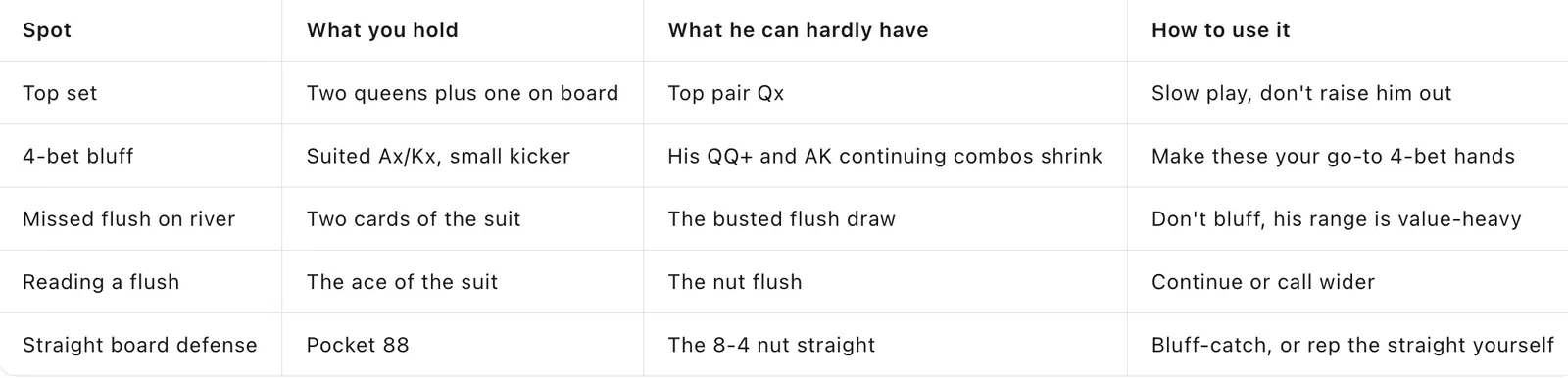
Blockers aren't some mystical high-level concept. It's just translating "what do I have" into "what can't he have."
Hold back with top set, pick the right hands to 4-bet, and glance down at your two cards before bluffing that river. Build these habits and a lot of decisions you used to guess at become decisions you calculate.
Next time you want to bluff a river, look at your hand first. The story you're trying to tell might be sitting in your own two cards.