The preflop re-raise is your main tool for picking up dead money in tournaments. But before you fire, check three things: your own stack, what's left in your opponent's stack, and whether your table image can still take the heat. On sizing, skip the min-raise. Default to about 4x the original raise. If they call or raise you back anyway, shut it down and cut your losses.
In a tournament, you can't sit around waiting for premium hands. The blinds keep climbing, and every few orbits there's a pot nobody really wants. That's dead money. It belongs to whoever reaches for it first.
The preflop re-raise is how you reach. It keeps people honest, and it tells the table every pot runs through you. But the move doesn't work just because you decided to use it. Before you pull the trigger, run through three questions.
Three Questions Before You Pull the Trigger
1. Can your own stack afford it?
If you're short, or the re-raise would cost a big chunk of your chips, drop the idea right there.
The logic is plain. The hand you're bullying with usually isn't much, so you're really gambling that they'll fold. When your tournament life is on the line, that's a bad gamble to take.
2. What's left in your opponent's stack?
Take an example. A player in late position raises to 600. Before you even look back at your cards, check what he has behind.
If he's down to 1200 or less, let it go, unless your hand is good enough to play for his whole stack. Here's the rule of thumb: once a player puts 25% of his stack into a raise, he's calling pretty much any re-raise. You can't bluff a guy who's already glued to the pot.
3. What does he think of you?
If you've already run this play on the same player a few times, cool off and wait for a real hand.
If he looks tilted, or you suspect he's figured you out, stay away from him for a while. Give him time to settle down, or give your image time to clean up. Nobody enjoys getting re-raised preflop over and over. Once or twice, fine. After that, people snap, and a snapped player does crazy things, like going to war against you with garbage.
How Big Should the Re-Raise Be?
The whole point comes down to one thing: your raise has to make him not want to play this pot anymore.
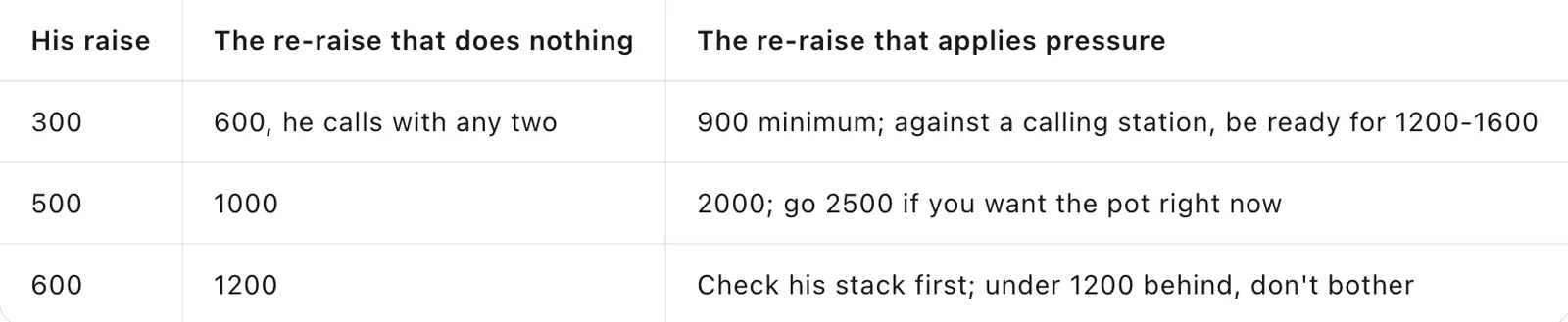
Here's how to do it wrong. A player in late position raises to 600, and you re-raise to 1200 from the big blind with Q2o. What is that? That's an invitation. At that price he's calling with any two cards. You've built a big pot out of position with a bad hand. Lose-lose.
Every opponent reacts to sizing differently, so watch for it during the hands you're not in. One I logged: Player X raises to 300, someone re-raises to 900, and X calls without hesitating. He later shows QT.
That's intel. Against a guy like X, 900 scares nobody. If you want to steal his 300, be ready to put 1200 to 1600 out there.
When you don't have a read on how someone handles re-raises yet, go with the standard size: about 4x the original raise. He makes it 500, you want to steal, make it 2000, or 2500 if you mean it. That size buys you two things. You take the pot down far more often, and you get instant information. If he can call that, or even raise you back, you're almost certainly up against a real hand. Time to fold the tent and walk away.
There are plenty of ways to grab dead money, especially in tournaments where the blinds never stop rising and you don't get to pick your spots. Nobody wins a big tournament by waiting for hands.
Keep your attention on the table, keep track of your image, find the pots nobody wants, and take them before the flop.
Next time someone raises in front of you, don't reach for the muck so fast. Run through the three questions. Then remember the 4x rule.