Here's something fun.
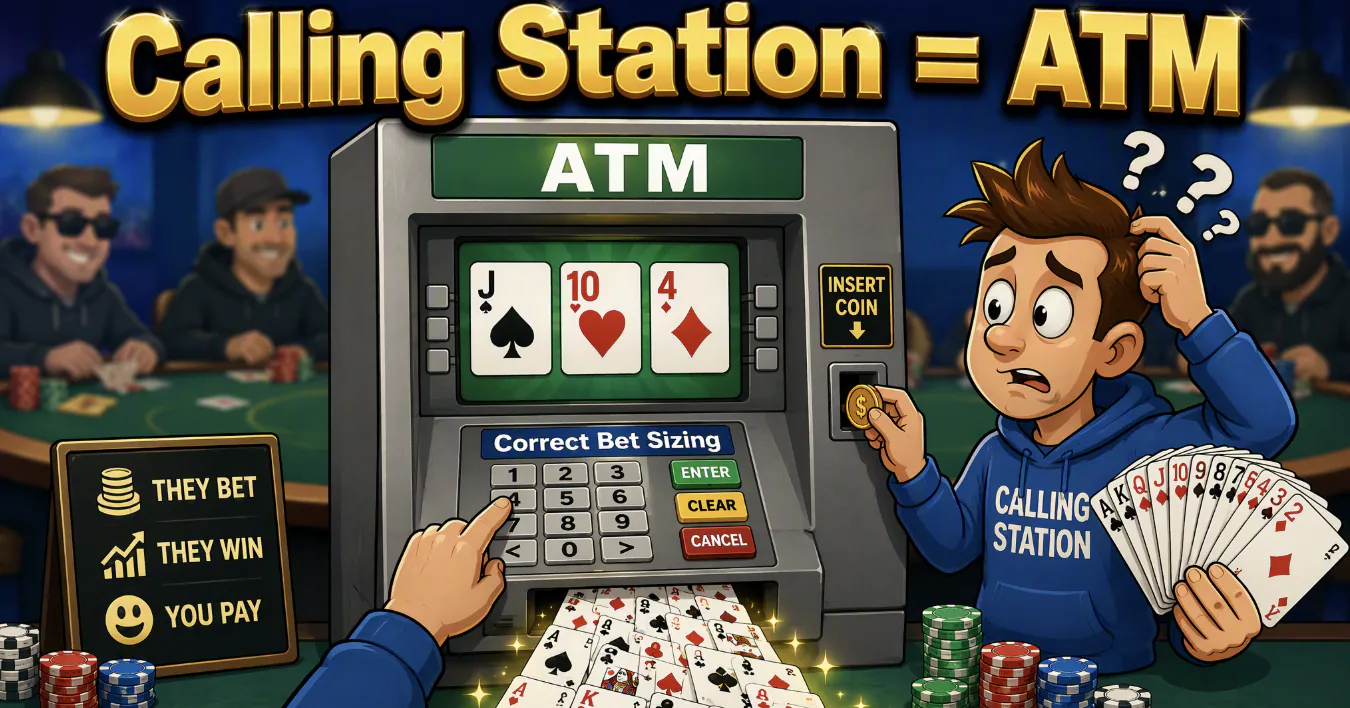
At any fixed stake, the regulars all bet pretty much the same way. What size means what strength, everyone keeps the same mental ledger.
Read that ledger, and you can read their hands. Work the ledger, and you can feed them false signals too.
The two moves below come from years of playing $2/$5 and $5/$10 in Las Vegas. Both are built on one idea: use off-script bet sizing to manufacture tells and let opponents make the mistake for you.
Move One: The Tiny Turn Bet
$2/$5 game. An aggressive player opens to $20, the button calls, and I call from the big blind.
Flop comes A-7-5. I check, the raiser bets $45, the button folds, I call.
Turn is a 2. With $152 in the pot, I bet $50.
At this stake, that size is a sentence in plain text. It says: "I have an ace, but I hate my kicker. I'll toss out a small bet and find out where I stand."
With a real kicker, or two pair or better, most players either check or fire at least $80. That kind of hand wants to charge admission. It's not out there asking questions.
The aggressive guy speaks this language fluently, of course. He raised, and his message was just as blunt: "You're beat. Get out."
And that's exactly where the opportunity hides.
When you actually want to build a big pot, use that small bet to bait him. He'll build it for you.
The same move works as a bluff. Say you're holding 8-6, or a flush draw, on a board of A-7-5-2. If you check, he probably checks back, and you never get a chance to steal. But throw out that little bet and an aggressive player will often raise to take the pot away. That's when you come back over the top.
What does that look like to him? It looks exactly like a set.
Against aggressive players, faking the small bet to draw the misread, then springing the trap, has worked for me over and over.
Move Two: The Over-Protection Flop Bet
Same $2/$5 game. Two limpers up front, I raise to $25 from late position, and the big blind plus both limpers call.
Flop comes Q-J-7. It checks around to me. The pot is $102. I bet $120.
Overbet. Another textbook sizing tell.
When a standard $2/$5 regular makes this bet, his hand might as well be face up: top pair with a good kicker, or an overpair. He believes he's ahead and wants value, but he's scared of all the draws behind him, so the bet blows past the normal ceiling.
Translated, the bet says: "This pot is mine. Everybody go home." If it ends right there, he's happy.
Most of the time, everyone does exactly what he hoped and folds.
I call anyway. Because I've already got him read: medium strength, over-protecting. Someone holding a real monster rarely bets to end the hand. That sizing locks him onto AQ or KK, more or less.
Even better, you can run this sizing in reverse.
Not long ago I played a nearly identical hand. Same preflop action, same Q-J-7 flop. I had AK and fired the overbet. The first player folded instantly. The second was a regular at this stake. He tanked for about 90 seconds, then folded. The last guy mucked in a flash.
That second player's hand? I'd stake money on QT or Q9. He doesn't normally fold top pair to one bet on the flop. But my bet wasn't a normal bet. It was the "over-protection" bet he knows by heart.
He knows what that size means. So, good student that he is, he folded top pair to me.
Bet sizing tells carry a lot of weight in my live game.
Once you read them well, every chip that goes into the pot tells you something about the hand behind it. When I can, I even leave opponents room to bet, just so they keep talking.
Of course, I'm not the only one using this stuff. Most regulars speak the sizing language too.
But that's the thing: because everyone speaks it, their reads harden into habit. Habit is a leak. Break the script once in a while and they'll misread you. A misread becomes a mistake.
The better you know these tells, the more leaks you get to pick at.
So next time you sit down, don't just stare at your own two cards.
Watch what they bet. Ask yourself what that sentence means.