JJ: The Most Misunderstood Hand in Poker
Pocket jacks are officially the 4th-best starting hand. Yet ask around any table and nine times out of ten you'll hear: "I really don't like JJ." The harsher version: "I've literally never won with this hand."
Why? Because JJ looks like a monster before the flop, and can fall straight from heaven to hell after it — any Q, K, or A on the board instantly cuts it down to size.
Then again, it IS two face cards. And it IS a pair.
Maybe what we fear isn't the hand itself, but the ending we've already imagined. Whatever you fear comes to pass — look up Murphy's Law.
Play long enough and one truth sinks in: losing one hand with JJ is luck; losing a hundred hands with JJ is not a luck problem — it's a you problem.
Let's settle JJ once and for all.
What JJ Really Is: Three Facts
Everything that frustrates you about JJ comes from not seeing it clearly. This hand isn't cursed — it just has a very strong personality.
Fact 1: Only three pairs beat it, but a crowd of hands threatens it
The only bigger pocket pairs are AA, KK, and QQ — sounds safe, right? Wrong. Every combination built from A, K, and Q is a threat: AK, AQ, AJ, even KQ, KJ, and QJ are all aimed straight at JJ's head.
So playing JJ like QQ-AA will burn you nine times out of ten. The sane approach: treat it as a medium pair.
Fact 2: JJ's value lives preflop — postflop it falls off a cliff
Someone already ran the numbers. Holding random cards:
- Flop comes ace-high: about 21.7%
- Flop comes king-high: about 18.4%
- Flop comes queen-high: about 15.2%
- Add them up: the flop contains an overcard to your jacks 55.3% of the time — more than half the time, JJ lands already second-best. And that's before counting the straight and flush possibilities JJ hates.
Fact 3: In a raised pot, overcards become even more likely
The logic is plain: most people raise when they hold aces, kings, and queens. So once someone raises or re-raises preflop, JJ's chance of facing overcards isn't 55.3% — it's higher.
Thousands Misplay JJ, But There Are Only Two Mistakes
Players describe JJ like this: too good to fold, too scary to call — pure agony. But review enough hands and the mistakes collapse into just two extremes.
Mistake 1: Too Aggressive
Jamming stacks preflop impulsively, or 3-betting and 4-betting in spots that clearly call for a call. One player put it perfectly: "Every single time I try to play JJ aggressively, something goes wrong."
Mistake 2: Too Cautious
Playing scared and passive, missing raises that are obviously profitable. Another player's exact words: "This hand must be played carefully — never act before the flop, and if an overcard flops, run for your life."
Both attitudes are wrong. JJ can't be played like QQ or KK — you can't just slam it all-in preflop whenever you feel like it. At the same time, playing JJ (or any hand) means reading more than the board: stack depth, position, and opponent all matter.
Some ground rules to pin on the wall:
- JJ is the 4th-best pocket pair;
- Raise with JJ preflop over 70% of the time;
- Thin the field preflop whenever possible;
- Facing a re-raise, call with caution;
- JJ is weaker in cash games than in tournaments.
The Right Way: Check Stack Depth First
The first thing to look at when playing JJ is the effective stack — the smallest stack in the hand, i.e., the most you can possibly win.
Scenario 1: 30-40BB effective — stop overthinking, shove
At this depth, very few hands beat you preflop, and most players will call off with a wide range at this stack size.
Example: a $200 buy-in tournament, blinds 100/200, effective stack 35BB. You open J♠J♥ to 450 from the cutoff, the button 3-bets to 1100, the blinds fold, and it's back to you.
The button's 3-bet could be for value or a bluff. If you shove, the range he'll call with is one JJ performs very well against — punch it into an equity calculator and JJ's equity is genuinely strong. And since he might fold every bluff he has, this shove is just filthy profitable.
Even if he really does have QQ+, or you lose a coin flip against AK — that's a cooler. It happens. Move on.
But does that mean you shove every time at this depth? No — position still matters.
Same hand, different script: this time you open JJ to 450 from early position (under the gun), it folds to a middle-position player who 3-bets to 1000, then the cutoff 4-bet jams, and the button jams too.
If you don't fold JJ now, when will you? The button shoving after two all-ins is a screaming danger sign — he has AA or KK an awful lot of the time. JJ isn't built for a bloodbath. When the storm comes, run.
Scenario 2: More than 40BB effective — more judgment calls
Once stacks get deeper, shoving stops making sense, and three questions take over:
- Where is the fight happening? In late-position battles (button vs. small blind), ranges are wide and you can raise more;
- What if it's early positions? Under the gun versus the hijack — everyone's tight, so be much more careful;
- What's the opponent's style? Tight or loose? That decides whether your raise is for value or a donation.
The Most Important Lesson: Don't Marry JJ
This advice applies to every big hand, but it fits pocket jacks best of all.
We all know JJ is mostly unplayable when an overcard flops — yet some players simply can't fold it.
Picture this: you 3-bet preflop and one opponent calls. The flop comes Q♦8♦7♦ — an overcard, a flush draw, and straight draws; this board is soaking wet. Do you c-bet here?
It doesn't mean auto-giving up on every board like this, but extra caution never hurt anyone: checking first to see what develops is safer than firing away.
In messy spots like this, reading the opponent becomes everything: if they're tight, just let it go; if they're hyper-aggressive, an occasional hero call is fine. Factor in their position and bet sizing too.
Folding JJ can genuinely hurt. But never forget the saying —
JJ usually wins a small pot or loses a big one. Wise up!
The Whole Article in One Picture:
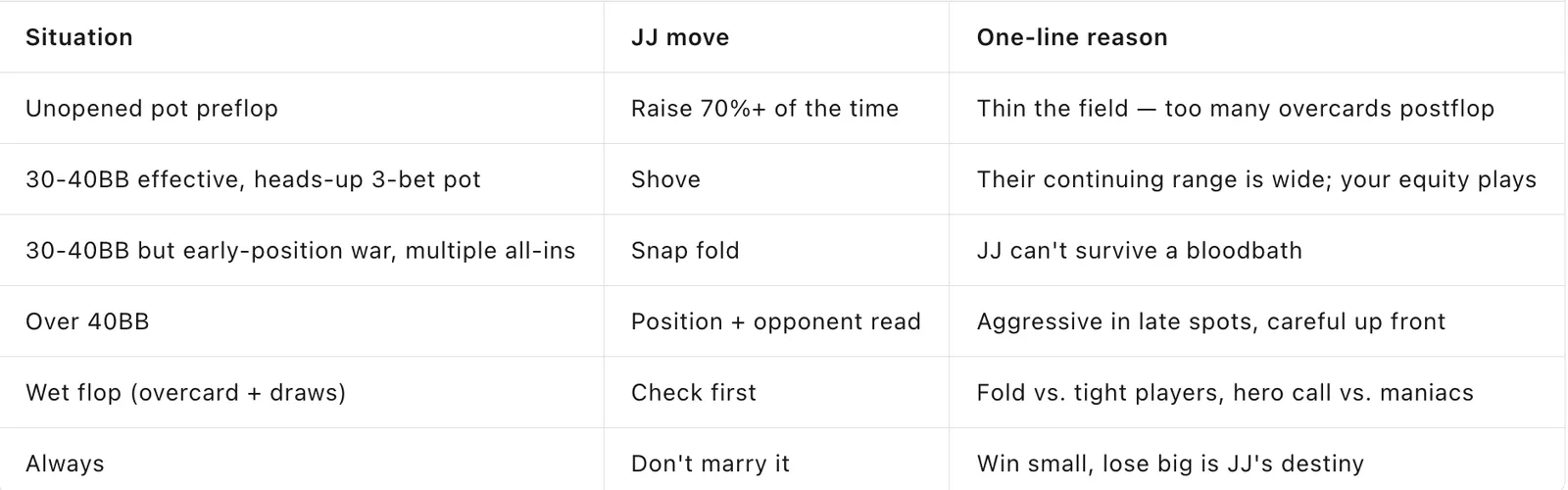
JJ doesn't come around often, so treat it like a guest when it does. The problem was never that the hand is cursed — it's that too many players play it like QQ, or fear it like 72.
Remember three sentences: raise it like a monster preflop, evaluate it like a medium pair postflop, and never marry it in deep water. Do these three things, and JJ transforms from "the hand you never win with" into a steady earner.
What you fear isn't JJ — it's the ending you imagined. Read the board, read the stacks, read the opponent — and leave the rest to probability.