the first three sections are data-heavy theory. If you're newer to the game, or a hands-on player who'd rather skip the math, jump straight to Part 4 for the distilled takeaways — no shame in that, I'm the one suggesting it.
First, the Headline: Small Flushes Get Crushed More Often Than You Think
The biggest trap of playing small suited connectors deep-stacked isn't "you won't hit." It's this: when you finally do hit your flush, watch out for reverse implied odds — you think you've struck gold, but the guy across from you has a bigger flush, and your 200bb vanishes in one hand.
So how likely is flush-over-flush, really? I simulated a typical scenario:
- You hold 5♦6♦ — the bottom end of the suited-connector family;
- Opponents' ranges run from tight to loose: 10%!3% up to 45%!3% (the top 3% excluded because those hands usually 3-bet preflop and never see a multiway pot);
- Opponent count: from 1 up to 4.
- The results are blunt:
- Against tight players (10%!3% average range): when you flop the flush, each extra opponent adds about 5.9% to the chance that at least one of them also flopped a flush; in a 5-way pot, that's 23.8%. Sure, tight players rarely build 5-way pots — but the number still instructs.
- Against loose players (45%!3%): each extra opponent adds about 3.7%, putting a 5-way pot at 14.8% — very close to a loose, splashy live full-ring game.
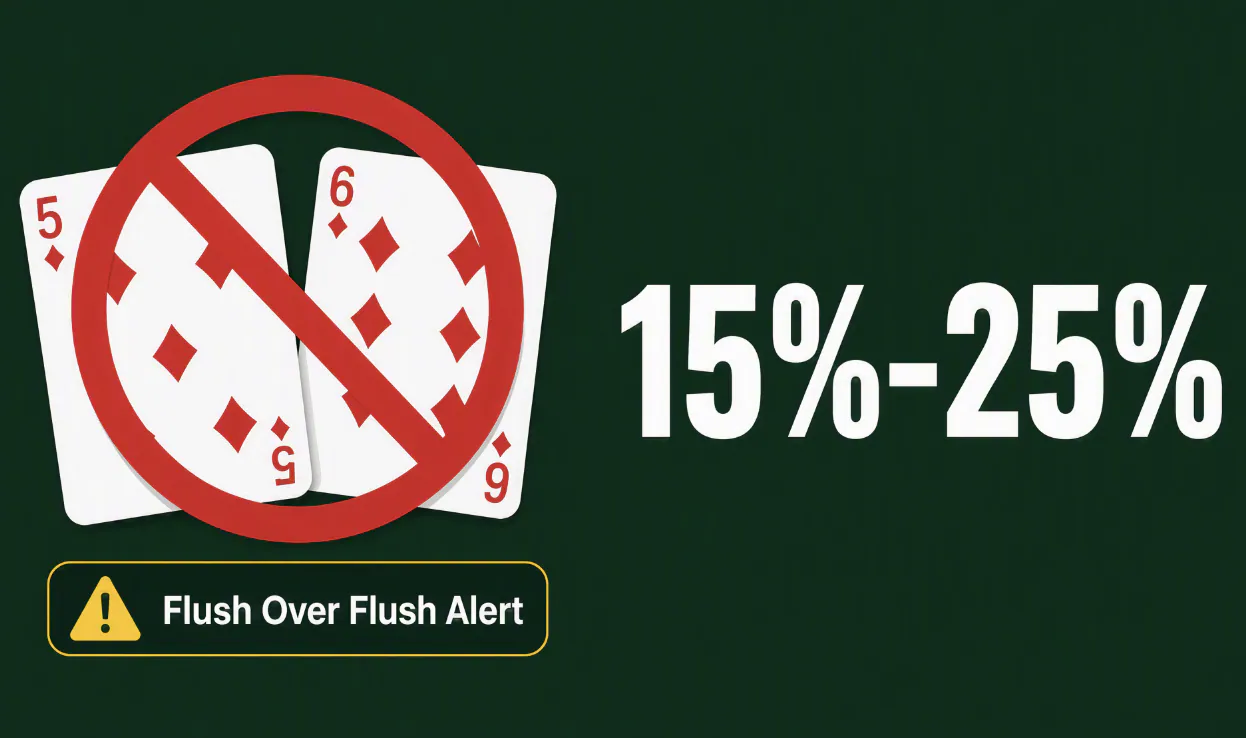
- One-line summary: when there's no suited-ace blocker around, in a 5-way pot where you flop a flush, at least one opponent also has a flush 15%-25% of the time. Roughly once in four to seven tries. Still want to pile it in blindly?
The Suited-Ace Blocker: One Card Cuts the Risk in Half
As mentioned in my earlier column, the suited ace's blocking effect is no small thing. Two cases to separate:
Case 1: the A♦ is in YOUR hand. Holding A♦6♦ instead of 5♦6♦ reduces the chance an opponent has a flush by 11.7% to 53.7% (the tighter they play, the bigger the cut). Simple reason: ace-suited combos make up the biggest chunk of any suited range, and with the A♦ in your hand, those combos simply don't exist.
Case 2: the A♦ is on the board. With 5♦6♦, a flop of Q♦8♦2♦ and a flop of A♦8♦2♦ are two different worlds — the latter physically deletes every nut-flush combo from your opponents' ranges.
So remember this: before you chase a flush, ask where the ace of that suit is. In your hand or on the board — half your worries are gone. In their ranges — you're drawing to the silver medal.
The Cooler Rate When You Flop a Flush: Same as Facing One
Now the data that should keep you up at night: when you flop a flush with 5♦6♦, the probability of being coolered by a bigger flush is basically equal to the probability of facing a flush at all. Any three-flush holding in their range is almost always bigger than yours.
"But what if I play bigger suited cards, like Q♦6♦?"
The answer is counterintuitive: the cooler rate stays big. Why? Because a huge share of suited hands are A-x suited and K-x suited — your queen-high flush still loses to any ace-high or king-high flush. The numbers: each additional opponent adds about 4% to Q♦6♦'s cooler rate; in a 5-way pot, that's 4×4% ≈ 16%.
One in six times, hitting your flush means shipping your stack. I'll admit — when I first ran this number, I had to double-check it.
Making Your Flush on the Turn Doesn't Save You Either
Beyond flopped flushes, the more common line is hitting on the turn — flop flush draws have the odds and implied odds to call once, so everyone sticks around. What's the cooler rate for "turned my flush"?
The simulation says: basically the same conditional probability as the flopped-flush coolers. Arriving one street later buys you no extra safety.
The Takeaways: Why "Flush Chasers" Don't Make Money
Wherever this game is played, there's a crowd of flush chasers — players who chase flushes for the sake of chasing flushes, small ones especially. But run the full accounting, and it's just not a profitable play:
1. Flush draws are painfully obvious. Three cards of one suit sit on the board and the whole table knows what you're up to. The implied odds can't compare to a hidden straight — when your straight gets there, nobody sees it; when your flush gets there, half the table clams up.
2. On three-flush boards, the opposing hand strength is naturally sky-high. Top pair without a big flush redraw is good for maybe one street of bluff-catching or thin value; two pair can hardly call three streets. And when a small flush gets into a raising war, the other side is usually a bigger flush or a set you're barely ahead of. Unless you're up against a calling station or a maniac fish, playing small flushes on three-flush boards means winning small pots and losing big ones — and it gets worse the deeper the stacks and the more players in the pot: the monster you can't fold runs into a bigger monster more often than you'd like.
3. And the final accounting is brutal:
- Suited hand flops a flush in a multiway pot: ~0.8%;
- Flops a flush draw: ~10.5%;
- The draw completes on the turn: ~19% on average.
- Multiply it out: a small suited hand actually holds a flush by the turn only about 2.8% of the time. And in that 2.8%, the EV it wins is modest — while 15%-25% of those times it's staring at a cooler that costs a big chunk, or all, of the stack.
- Win a little when you hit, lose everything when you're unlucky — that's what reverse implied odds look like up close.
The Whole Article in One Table
| Question | The data's answer |
|---|---|
| 5-way pot, you flop a flush — chance an opponent has one too | ~15%-25% (23.8% vs tight, 14.8% vs loose) |
| Risk reduction from holding the suited ace | Opponent's flush chance drops 11.7%-53.7% |
| Q♦6♦ cooler rate when flopping a flush (5-way) | ~16% (+4% per extra opponent) |
| Total chance a small suited hand makes a flush by the turn | ~2.8% (0.8% flopped + ~19% of draws completing) |
| Verdict on small flushes, deep-stacked | Win small, lose big — unprofitable long-term |
Suited hands are weaker overall than most players think, and small suited connectors in particular only look beautiful.
When you play small flushes, respect the reverse implied odds lurking behind them — in the specific spot where you make your flush, getting coolered is genuinely not rare. Next time you're deep, your baby flush gets there, and the opponent wants to play for stacks — remember that 15%-25% before you decide to pile it in.
Don't lose your 200bb and then whisper "it was just a cooler" — was it really just a cooler?