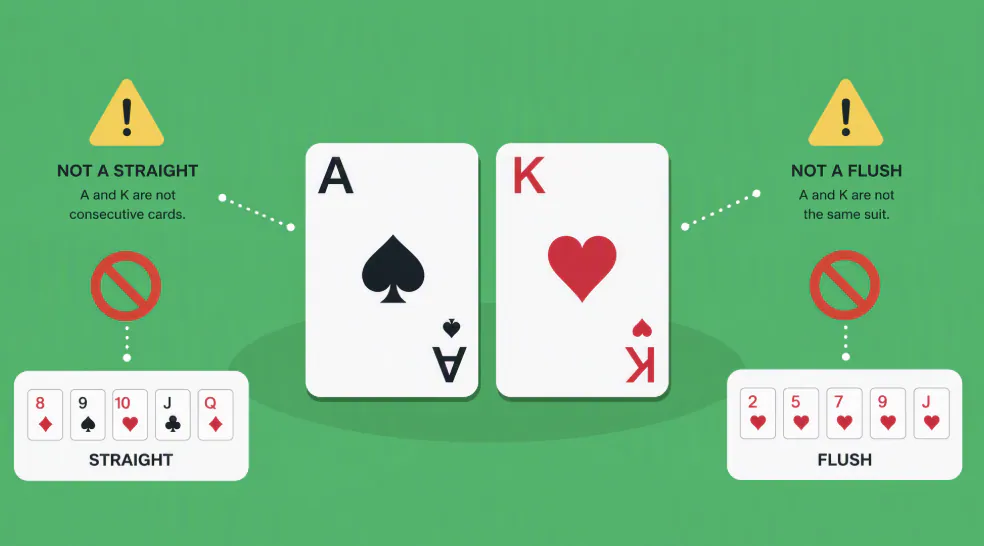
Overcards means one or both of your hole cards are higher than every community card on the board.
Example: you hold A-K and the flop comes 5-7-Q. Your ace and king both outrank everything out there — that's "two overcards."
Sounds lovely: two big cards in hand, and either one pairing up gives you top pair, right? Hold on. That exact thought is where countless beginners start lighting money on fire.
The Most Common Mistake: Treating Overcards Like a Draw and Chasing to the River
Let's do the basic math. With two overcards, the outs to top pair are 6 (3 aces + 3 kings), which works out to roughly 7-to-1 against hitting.
That's already a borderline number. But here's what beginners keep forgetting: your outs are often the other guy's outs too. The ace you're waiting for makes your hand bigger — and might make his hand bigger still.
Classic spot. You're in late position with A-K, three players limp in front of you, and you call along. Flop: 9-8-T — two of one suit, three connected cards, a textbook danger board. The first player bets, two more call, and it's on you.
Chasing with overcards here is seriously dangerous. Let's walk it through:
- Say the turn brings your A or K and you make top pair — any card of that flush suit gives an opponent a flush that crushes you;
- Say the A or K comes in a "clean" suit — you still need the river to avoid any 7, any J, and anything in the scary suit;
- And even if your top pair dodges straights, two pairs, and sets — those "clean" aces and kings only win when the opponent does not hold A-T, K-T, A-9, K-9, A-8, or K-8.
- Count how many bullets you have to dodge. That's not chasing a draw. That's waiting for a miracle.
Discount Your Outs: The Halving Rule
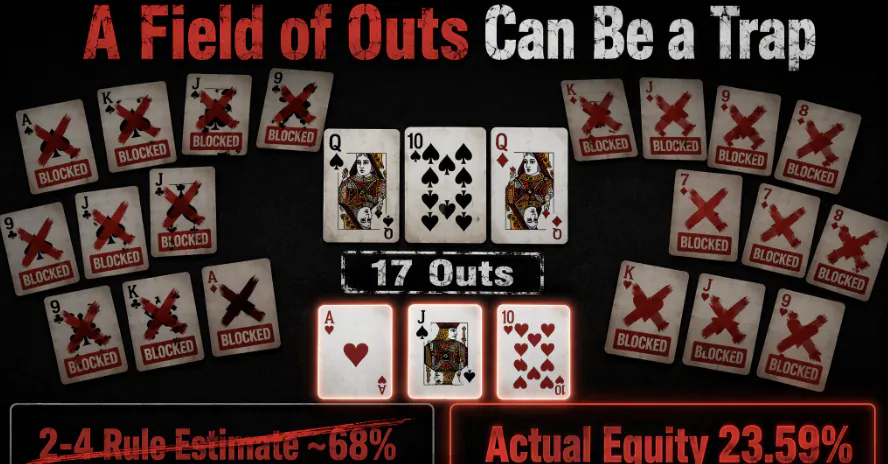
When you're chasing with overcards, one problem never goes away: the cards you're waiting for might be helping your opponent at the same time.
Another example. The flop is 7-J-6, your opponent bets, and you hold A-K. If his hand is something like A-J, K-J, A-9, K-9, A-5, or K-5, then when your A or K lands — you make top pair, and he makes two pair. You gleefully shovel chips in and discover you were second-best all along.
So whenever you suspect the opponent needs the same cards you do, discount your outs. The most practical method: cut them in half.
In the example above, your outs drop from 6 to 3. If the pot odds still work with honest outs, fine, continue — but look: with only 3 real outs, the pot odds almost never add up. Which is the answer in disguise: most of the time, fold.
Only These 4 Situations Justify Chasing With Overcards
Overcards earn the right to continue only when these specific conditions are met:
- The pot is huge — you need at least 7-to-1 for the chase to pay;
- Nobody has bet in front of you, and very few players are left to act behind you — the more players behind, the more likely a raise, and a raise makes chasing overcards too expensive and turns it into a mistake;
- Very few opponents, period — the more players chasing alongside you, the less likely your top pair holds up. High pairs perform best against one or two opponents; in a six-way flop, chasing overcards is a no-go;
- The flop looks safe — your outs aren't anyone else's outs.
- A footnote on condition 4: the safest flops are the ones with no flush possible and no connected cards. But even there, don't celebrate too hard when you pair your ace — tons of players show up with any Ax, meaning they've either already paired the kicker card or they're waiting on the same ace you are. Shared outs are a threat forever. Never fully relax.
- One sentence to sum up this section: the more likely your outs are shared, the more eager you should be to fold.
A Different Kind of "Continuing": Betting When You Miss — That's an Attack, Not a Chase
An important distinction here. Everything above is about "deciding whether to chase based on the board." What follows is something else entirely: the continuation bet.
Plenty of times, you raised preflop and missed the flop — and you should bet anyway, to keep the pressure on.
Simple hand: you're in late position with A-K, an early-position player bets, you raise, he calls, everyone else folds. Flop: 9-8-3, and he checks.
Even though all you have is ace-high, you must keep betting here. Why? Because there's a 66% chance your opponent got nothing from this flop either. His check usually means he missed. You bet, and all the pressure sits on his side of the table.
See clearly: this is not chasing with overcards — you're not waiting for outs, you're picking up the pot.
But what if he leads out instead of checking? Then you're back to the logic from section three: weigh the odds, factor in what you know about him (bad player? habitual bluffer? solid regular?), and then decide whether to continue.
Rule of thumb: with no more than 2 opponents, keep betting from any position; with 3 opponents, only bet when you're in late position and everyone has checked to you.
The Whole Article in One Table
| Situation | Move | One-line reason |
|---|---|---|
| Two overcards, thinking of calling to chase | Default: fold | Only 6 outs at ~7-to-1 — already marginal |
| Outs might also help the opponent | Halve them, then do the math | Your top pair might make his two pair |
| Big pot + nobody behind + few opponents + clean board | OK to continue | You need all four to make it worth it |
| Six-way pot, dangerous board (suited + connected) | Snap fold | The pair you hit can't dodge that many bullets |
| You raised preflop, missed, opponent checks | Keep betting | He's ~66% to have missed too — pressure wins pots |
The most deceptive thing about overcards is how much "hope" they seem to offer.
Two things to remember: when chasing, halve your outs; when attacking, treat a miss as a weapon. The first keeps you from donating, the second wins you pots that were never yours. Next time you're holding AK staring at a flop that gave you nothing, don't ask "how many cards can I still hit?" Ask first — are those the same cards he's waiting for?
When your outs help him too, they're not outs. They're traps.