The most commonly butchered flop texture in no-limit hold'em is the one where all three cards share the same suit — we call it a three-flush flop, or a monotone flop.
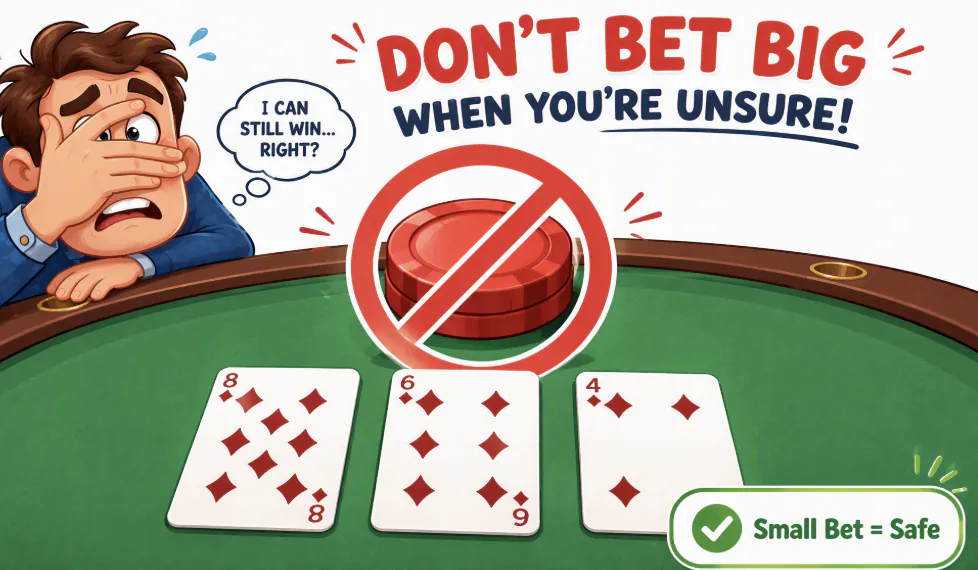
Something like 8♦6♦4♦. Three diamonds staring up at the whole table.
Beginners react to this extreme board with pure emotion, and they split into two camps:
- The bombers: fire massive bets with top pair or overpairs, trying to scare every "flush chaser" out of the pot;
- The ostriches: check-fold constantly and surrender to anyone who bets.
- Both are poorly thought out. But if we're ranking which is worse — it's the first one. Let's break down exactly why.
The Big-Bet Fallacy: How Toxic Is $1/$2 "Table Wisdom"?
Sit down at any $1/$2 live table and soak up the conventional wisdom floating around, and you'll absorb a pile of illogical ideas that players keep passing to each other like a cold. Most players in these games are nowhere near expert level — then again, look on the bright side: that's exactly why some of them keep paying us.
The most classic piece of toxic wisdom: "AK is a dangerous hand, I fold it preflop."
Slightly less harmful but just as wrong is today's topic: "When the flop is all diamonds, you HAVE to bet big — somebody's definitely chasing the flush."
"Chasing the flush" might be the most loaded, most emotional phrase at a $1/$2 table. Players who blast big bets with A♥A♣ on 8♦6♦4♦ in a three-way pot are suffering from tunnel vision — they can only picture two things:
- I currently have the best hand;
- Some opponent holds a single diamond and is chasing me.
- Here's the problem: against two opponents, condition 1 alone is already unlikely. What's in their ranges? Either two big cards that didn't 3-bet preflop (like K♦J♠), or pocket pairs other than 88, 66, and 44 that weren't strong enough to 3-bet. And the probability that condition 2 — exactly one diamond — is true? Also small.
- Multiply two unlikely events and you get an even more unlikely event. The script "I'm ahead AND he's chasing" is almost never true at the same time.
- Players in love with the big bet ignore every other scenario and fixate on the one picture where a big bet looks satisfying. That's range blindness — as if the opponent's range contains exactly one type of hand.
Why the Small Bet Is Theoretically Correct
Keep this premise in mind: the big-bet-with-a-pair plan only works when "the opponent holds exactly one diamond AND you're actually ahead" are both true. If either condition fails, a small bet is simply much better.
Example: against a hand like 9♠8♠, your big bet mostly folds them out — a small bet is the only size they'll call with any regularity. A big chunk of the opponent's range is made of these "might invest a little" hands.
That's what we call a thin value bet: the smaller size guarantees calls from most worse hands while limiting your losses when you're up against a better one. You win on both ends.
One more piece of common sense: everyone loves playing suited hands preflop. So on these boards, both "already has a flush" and "has zero diamonds" are extremely common — the opponent's range is polarized to two extremes, with a thin middle.
- Against J♥T♥ (no diamonds at all): zero reason to bet big;
- Against J♦T♦ (a made flush): betting big just inflates your losses and hammers your win rate.
- So on monotone flops, the small bet is clean, theoretically correct play: it collects thin value and keeps you from ending up an underdog against the calling range.
- If you size up purely because you hate the idea of a fourth diamond coming — to a point where your win rate when called is miserable — that's the poker version of chopping off your toes to fit the shoes.
- And consider this detail: nobody folds A♦J♥ to your flop bet here — they've got the ace of diamonds and they're chasing the nut flush, so they'll see a turn no matter how big you make it. Which means if that fourth diamond does roll off, you'll be deeply grateful your flop bet was small. The big bet is only a good play in the universe where the turn isn't a diamond — and you don't get to choose the universe.
When a Big Bet IS Right: The Exploitative Deviation
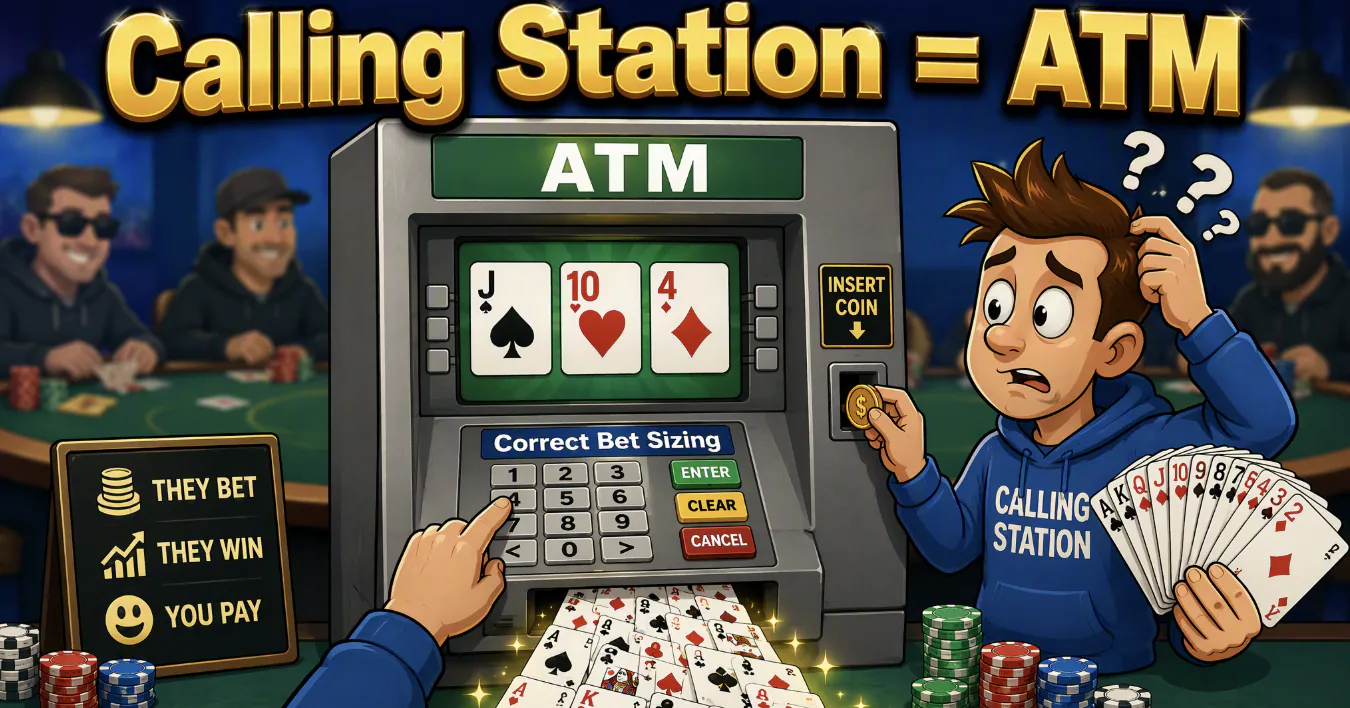
So is a big bet on a monotone flop never correct? Not quite. One spot calls for it: when you hold a genuinely strong made hand or a powerful draw, and the person across from you is a stubborn calling station.
Here's the logic: if this opponent calls preflop with piles of offsuit junk, then on 8♦6♦4♦ their range is stuffed with single-diamond hands. And what's a calling station's trademark? They'll pay you off across multiple streets even with a lousy draw.
Don't be polite about it — with hands like A♦7♦ (the nut flush) or even 4♣4♠ (bottom set), size the bet up and let their stubbornness fund your stack.
One clarification: I'm not saying you must always bet small or check on monotone flops — I'm saying that's the theoretical default. And that's the beauty of poker: against plenty of player types, you can set the general rules aside and take whatever line maximizes your win rate in the game you're actually sitting in.
One-Table Summary
| Situation | Recommended size | Why |
|---|---|---|
| Default (one-pair type hands) | Small | Thin value + capped losses; big bets only push out worse hands |
| Opponent has zero cards of the suit | Small | A big bet folds them out — you collect nothing |
| Opponent already has the flush | Small / check | A big bet only grows your losses |
| Calling station + you hold nut flush / set | Size up | Exploit the stubbornness — even one-suited hands will hang on |
The monotone flop is a mirror — it reflects which players let emotion override range thinking.
Remember two sentences: small is the default; big is reserved for calling stations. Next time the flop comes three of a suit, don't rush to "protect" — ask yourself first: who exactly am I trying to scare away with this big bet, and who exactly do I expect to call it?
A big bet can't stop the fourth diamond from coming. It can only stop the hands that wanted to pay you.