ABC poker isn't all bad. Sometimes it's the best strategy at the table. Today I'll say a few words in its defense — and show you exactly which games reward plain, honest ABC play with real money.

What Is ABC Poker, Exactly?
Let's get the definition straight. ABC poker means:
- Play tight preflop — good hands only;
- Stay tight postflop with marginal hands — don't get attached;
- Never slowplay — hit a strong hand, come out firing;
- Value bet hard and often, but bluff far too little;
- Facing unusual aggression? Fold and move on.
- One sentence: when you have it, you bet it; when you don't, you're gone. No tricks.
- This style beats most low-stakes games, and the reason is simple: too many players misjudge their hand strength and call down with way too much junk. You play good hands and value bet; they pay you off with second-best holdings. That's the entire profit engine.
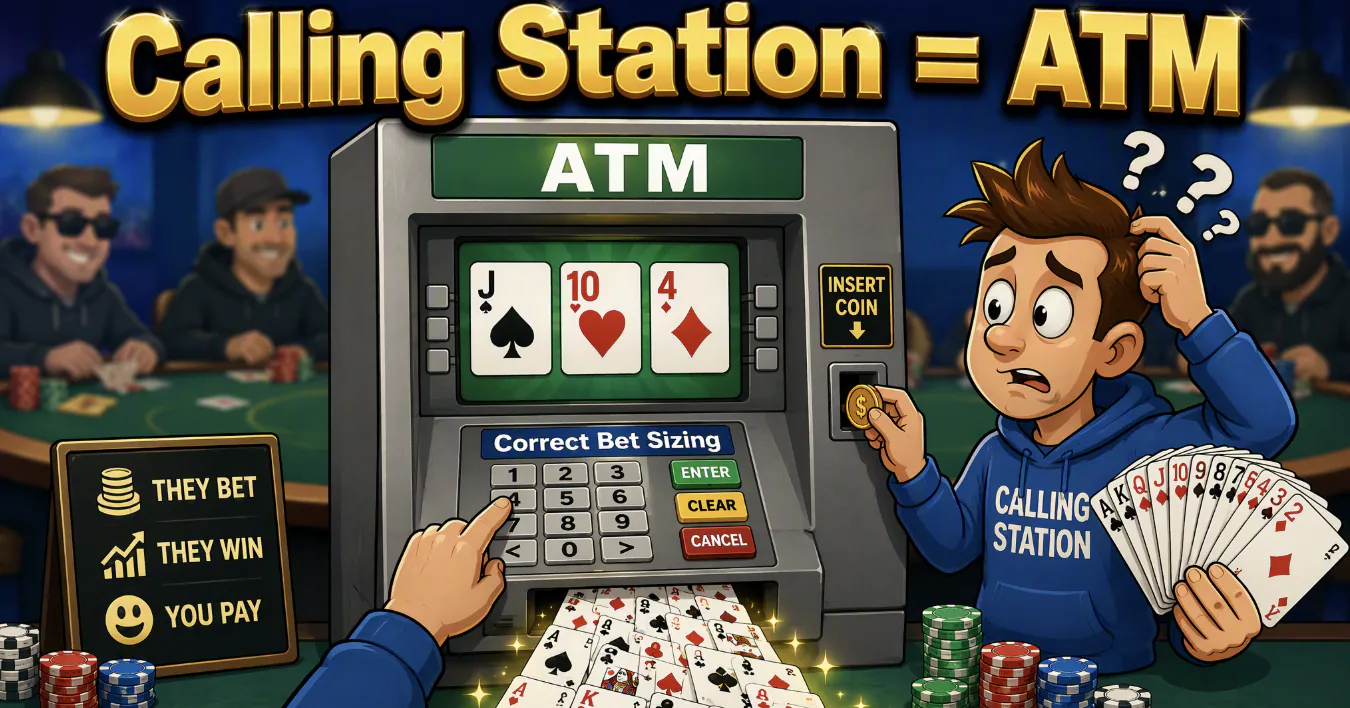
Know Its Limits: ATM in Soft Games, Donor in Tough Ones
ABC is a baseline strategy: it punishes the most common mistakes of bad players while keeping you from losing too much to good ones. But notice — it's not an "optimal" strategy. In soft, cozy games it grinds out steady profit. In tough games, it stops working.
Extreme example: a $25/$50 six-max table, and you're seated with five world-class players. Still want to play ABC? Prepare to get skinned. ABC's profit comes from exploiting mistakes — and strong players don't make any. There's nothing for you to harvest.
There's also a popular misconception worth killing: some players believe ABC is the "solid" approach, and that as long as they control their emotions — no boredom, no tilt — ABC alone will carry them to poker success.
Sorry, no.
What ABC offers is this: a pleasant game, a way to pass the time, and some modest winnings. If you want bigger profit and faster climbs through the stakes, don't expect it to give you things it never had.
The 3 Games Where ABC Actually Wins
The core of ABC comes down to three moves:
- Preflop: play strong hands, dump the marginal ones;
- Postflop: value bet hard with top pair or better;
- When you've got nothing — middle pair, weak draws — give the opponent zero action.
- The money comes from an asymmetry: opponents with nothing are still willing to give your value bets action, while you give them absolutely nothing when you're weak. Tight preflop play guarantees you simply show up with strong hands more often.
- Now the key question — which games supply these conditions?
Condition 1: A Table Full of Short Stacks
Short-stacked games are perfect for ABC, for two reasons.
First, players who buy in short tend to be noticeably weaker than deep-stacked players. Nothing inherently wrong with a short buy-in — that's just how it is. Weaker players love making moves with mediocre hands because they don't know how to properly value a hand across different board textures.
Second, short stacks make people looser with their wallets — they can lose less. Most players can shrug "whatever" and call $50 far more easily than $150.
So scan the table. See a bunch of half-stacks? You've likely got a lineup of casual players and "whatever" players. Sit down, play ABC, and let the returns come to you.
Condition 2: Showdown-Heavy Games
Some games, you won't see a showdown for twenty minutes: someone bets the flop, everyone folds; next hand, a turn bet, everyone folds again. Fold, fold, fold.
But some games run the opposite way — two or three players ride along to the river every single hand. This usually happens where everyone bets small: the game is $1/$2 with $150 stacks, yet the standard river bet is $25 or $30.
Whenever you're in a game with lots of showdowns and small bets, ABC should be your foundation.
At a table like that, triple-barrel bluffing with 77 on an ace-high board to "represent the ace"? Probably not a great idea — anyone who's called you twice has the ace for real and plans to call once more.
Instead, your job is: pick good hands preflop, make top pair or better postflop, and value bet the whole way, letting second-best hands foot the bill.
Condition 3: Opponents Who Rarely Bluff
This is the single best reason to run ABC. When opponents bet their good hands and check their weak ones, just do the same thing they do (with a little thought and minor adjustments).
Here's a concrete hand. You hold AQ in a $1/$2 game. Two players limp, you raise to $10, and one limper calls.
- Flop: K-T-4. Opponent checks, you check back.
- Turn: a 5. Opponent checks, you check again.
- River: another 5. Final board: K-T-4-5-5. Opponent checks once more.
- Now what? If you think he'd fold a hand like 66 to a bet, you can fire and take it. But you can also check it down.
- "Hold on," you say. "Isn't that way too passive? Shouldn't I be betting and driving the action?"
- What's the point of all that checking? Gathering information. Every check asks your opponent a question: "Hey, do you have anything?" A bet on the turn means "yes." A check means "no."
- And plenty of players — especially at $1/$2 — will answer you with zero disguise. He checks on K-T-4, and the question was "got a king?" His turn check says "no." And that answer is usually reliable.
- So if checking gets you free answers, why bet with a weak hand to ask the same question? Why not check, get your answer, and then decide?
- Sure, when you bet the flop and get called, you learn something too — "he's got something." But that information costs money, and it's often less useful than what a check gets you: he might call with a weak pair, a gutshot, or a strong top pair, and without firing more shells you can't narrow it down.
- Check behind instead, and he'll bet his top pairs and check his air. You get better information at a lower price.
- But careful — this is a perk reserved for playing bad opponents. Against genuinely strong players, this logic collapses instantly — check the flop with a weak hand and they'll shove that check straight down your throat.
- When opponents are passive and won't attack your checks, though, take the free lunch: check your weak hands and let them report their own strength. If they keep checking, treat them as weak and adjust. With showdown-value hands — ace-high, an unimproved pocket pair — check it down. With weaker holdings — queen-high, say — stab at the pot.
Final Thoughts
ABC poker is sometimes the perfect money-making strategy. When stacks are short or opponents love calling to showdown, your profit is a simple loop:
You make a hand, bet, get called. They make a hand, bet, you fold.
And when opponents don't bluff, you can even probe early with checks: you check ace-high, they check again — you're probably good. They bet? Fold, next hand.
Honestly, games that fit ABC this perfectly are getting rarer these days. But remember this: when the conditions are right, ABC poker is damn hard to beat.
There's no strategy that's right forever — only a strategy that matches the game in front of you.
ABC isn't embarrassing. What's embarrassing is running the wrong strategy in the wrong game and feeling great about it. Next session, check the table first: Are the stacks short? Are showdowns frequent? Do these guys ever bluff? If all three boxes are ticked — put the fancy plays away, play honest ABC, and collect the money.
The best player isn't the one with the flashiest moves — it's the one who prescribes the right medicine.