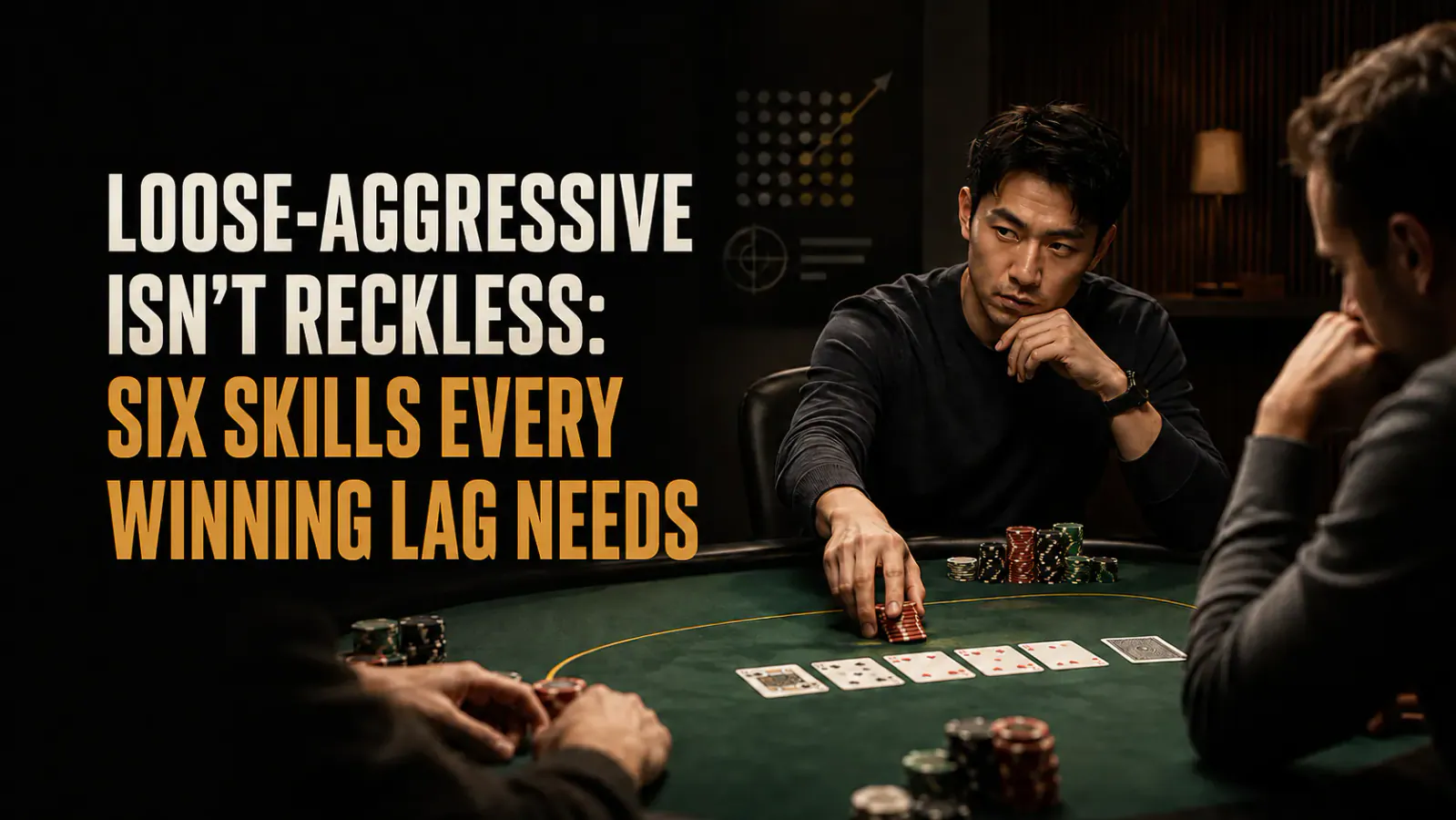
One of the most common players in poker is not the nit, the calling station, or even the genuine maniac. It is the player who describes himself as loose-aggressive.
He enters almost every pot, fires whenever he finds a backdoor draw, and launches an oversized river bluff because checking would not look aggressive enough. When the stack disappears, he rarely questions the strategy. He simply says, “That is the variance you accept when you play LAG.”
That is not loose-aggressive poker. It is uncontrolled poker with a more flattering name.
A winning LAG does enter more pots and apply more pressure than the average player. But the wide range is not random, and aggression does not mean pressing the bet button on every street. Loose-aggressive poker demands an unusually strong understanding of position, opponents, ranges, bet sizing, and timing.
Loose is the visible part. Discipline is what makes it profitable.
First skill: Widen your range for a reason
Many players define loose-aggressive poker by VPIP. They decide they must play 40 percent of their hands or they are not a “real” LAG.
That is a dangerous way to build a strategy.
VPIP is an output, not an objective. Reasonable frequencies change dramatically between heads-up, six-max, and full-ring games. Antes, stack depth, rake, table aggression, and the quality of the blinds all affect how wide you can profitably play.
A 40 percent VPIP may be reasonable in a specific environment and nearly indiscriminate in another. Winning LAGs do not chase a statistic that looks aggressive. They widen because the situation offers a concrete advantage.
Perhaps they have position. Perhaps the blinds overfold. Maybe a weak player has entered the pot, or an opener fails to defend against 3-bets.
A disciplined LAG can still fold king-queen or king-jack before the flop. Those hands look attractive in isolation, but they become vulnerable when the action, position, and opposing range are unfavorable.
There may also be rare situations where a very weak hand becomes a 3-bet bluff. That does not make any two cards a legitimate weapon. A hand such as eight-four offsuit has no useful high-card blocker and poor postflop playability. Unless an opponent is folding far too often and every other condition is favorable, the play usually creates a good story rather than good expected value.
Bluffing candidates with blockers, suitedness, and postflop potential are easier to manage. Suited wheel aces, some suited kings, and selected suited connectors often produce a more coherent 3-bet range than disconnected trash.
Loose-aggressive poker does not eliminate starting-hand standards. It makes them responsive to the environment.
Second skill: Treat position as information, not permission
Position is the lifeline of a LAG strategy.
Acting last lets you see what an opponent does before committing more chips. It improves pot control, value betting, bluff selection, and equity realization. Many marginal hands become playable only because position allows them to navigate later streets.
But “play wider from late position” is a starting principle, not an unconditional command.
Imagine you are on the button with two blinds who 3-bet frequently and defend well after the flop. Mechanically opening a huge range will keep placing you in inflated pots with hands that struggle to realize their equity.
If the blinds fold too much, the opposite adjustment is correct. You should steal aggressively because those specific opponents are failing to defend, not because the button possesses magical powers.
The direction of your observation matters as well.
Players on your left determine how freely you can open and steal. The more often they 3-bet, cold-call, or fight back postflop, the harder it is for the bottom of your opening range to profit.
Players on your right determine how often you can isolate weaker opponents and use position after the flop. A player who limps frequently and then surrenders too many flops creates repeated opportunities.
Position gives you an information advantage. It does not grant immunity from bad decisions.
Third skill: Know the next branch before taking the current action
A LAG enters more pots and reaches more marginal situations. If every decision begins only when the action reaches him, aggression eventually turns into improvisation.
Before raising preflop, you should already have answers to several questions.
Which hands continue against a 3-bet?
Which hands call, 4-bet, or fold?
If a blind calls, which flops support a high-frequency continuation bet?
Which textures require you to slow down?
The same preparation applies before betting the flop.
Which turn cards allow you to barrel after a call?
Which cards improve the opponent’s range?
How will your value hands, draws, and air respond to a check-raise?
This is not a fixed script. Poker has too many branches for any predetermined line to survive every response.
What you need is a simple decision tree. Know what happens when the opponent calls, what changes when he raises, which turn cards shift the range advantage, and whether the remaining stacks support another round of pressure.
Bet sizing, effective stacks, board texture, range advantage, nut advantage, blockers, and table image all belong in that tree.
Losing LAGs often plan only the current bet.
They know why they are continuation-betting but have no answer after being called. When the turn arrives, they fire again to preserve the story. By the river, they feel they have invested too much to stop.
A routine flop bet turns into a compulsory three-barrel performance.
Real aggression is not constant firing. It is betting with a clear idea of which developments justify continuing, changing gears, or ending the hand.
Fourth skill: Understand that table image changes your opponents
A loose-aggressive player must observe not only his opponents but also the way those opponents now perceive him.
If you have opened frequently, 3-bet several times, and collected multiple pots, the table will eventually respond. Some players call wider. Others begin 4-betting lighter. A few decide that any pair is strong enough to reach the river against you.
Your bluffing fold equity may decrease, while your ability to value bet more aggressively improves.
After you have remained quiet for several orbits, the first major move may receive more credit. That is not guaranteed. Some opponents barely notice your recent activity and care only about their own cards. Others remember every aggressive action from an hour earlier.
Table image is not the identity you assign yourself. It is the conclusion opponents draw from what they have seen.
You may think your image is “loose but skilled.” The table may simply believe you play too many hands. If that makes them call wider, reduce marginal bluffs and expand value.
If they continue folding excessively, keep applying pressure.
The purpose of table image is not to maintain a fixed persona. It is to profit from the mistakes opponents make while adjusting to that persona.
Fifth skill: Treat bluffing as expected value, not theater
The claim that bluffing is always negative EV is simply wrong.
A bluff’s profitability depends on how often the opponent folds, how much you bet, how much equity remains when called, and what future streets allow you to do.
Suppose the pot is $100 and you bet $50 with a hand that has no showdown value or remaining equity. You risk $50 to win $100. If the opponent folds more than one-third of the time, the bluff makes an immediate profit.
If you bet the full pot, risking $100 to win $100, a pure bluff needs the opponent to fold more than half the time.
Larger bets create more pressure, but they also require more folds. An overbet is not good because it looks fearless. It works when the opponent’s range contains enough hands that cannot continue and your value range can credibly use the same size.
Many real bluffs are not complete air. Draws, backdoor draws, and blocker-driven hands can improve after being called. Their expected value includes that remaining equity, so they require less immediate fold equity than a zero-equity bluff.
A strong bluff usually combines several conditions.
The opponent is capable of folding.
Your line represents a credible value range.
Your hand blocks some of the opponent’s strongest continues or retains meaningful equity.
The sizing puts the target portion of his range in a genuinely difficult position.
Future cards give you a workable plan rather than forcing you to surrender blindly.
Without those ingredients, bluffing quickly becomes chip burning.
Spectacular televised bluffs are memorable because viewers see the cards and understand the stakes. What makes elite players profitable, however, is not the handful of hero plays that appear in highlight reels. It is accurate range, sizing, and frequency management across thousands of ordinary pots.
Do not bluff to prove that you know how.
Bluffing is not a performance of skill. It is a tool for attacking an opponent who folds too much when value betting cannot do the job.
Sixth skill: Build a bankroll and mindset that can survive the strategy
A loose-aggressive style enters more pots and creates more large pots. Even when the underlying strategy is sound, the short-term swings are often greater than those of a tight-aggressive approach.
That means a LAG needs more respect for bankroll management, not more courage.
There is no universal number of buy-ins that fits every player. Game quality, rake, stack depth, win rate, and personal financial obligations all matter. One point is universal: if an ordinary downswing threatens your living expenses or forces you to change stakes emotionally, the bankroll is not adequate.
An insufficient bankroll quietly distorts decisions.
You avoid a thin value bet because another lost buy-in feels unbearable. Then you force a poor bluff because you want to recover the money quickly. The strategy still looks loose-aggressive from the outside, but the account balance is controlling every choice.
Emotional control matters just as much.
LAG players are not naturally immune to tilt. Repeatedly facing 3-bets, getting several bluffs called, or losing with strong value hands can erode anyone’s patience.
The difference is that a tilted LAG can lose money especially quickly. The normal strategy already contains more marginal entries and proactive betting. Once emotion corrupts those frequencies, calculated pressure turns into indiscriminate firing.
Useful tilt control requires more than telling yourself to stay calm.
Pause when you notice that one particular opponent is changing your normal range.
Leave when you realize a bet is motivated mainly by recovering the previous pot.
If your decisions become noticeably faster and you stop evaluating ranges and sizing, your strategic edge has probably disappeared for the day.
Bankroll management gives your edge time to materialize. Emotional control prevents you from destroying it before that happens.
LAG is a strategy, not an identity
Players love calling themselves aggressive, loose-aggressive, or fearless because those labels sound like expertise.
A winning LAG is not someone who bets every street or turns garbage into a huge pot and calls the outcome variance.
Winning LAGs widen their ranges, but they know why.
They apply pressure, but only against opponents who can respond by folding.
They run large bluffs, yet stop when the line no longer makes sense.
They exploit position without worshipping it.
They accept variance because their bankroll and decision-making process can withstand it.
Sometimes the best loose-aggressive strategy at a particular table is to remain quiet for several orbits. Sometimes nobody wants to fold, and the most profitable adjustment is not bluffing more but waiting for value and betting it relentlessly.
The hardest part of LAG poker is not learning how to press the accelerator.
The real skill is knowing when to press it, how far to press it, and when to take your foot off.