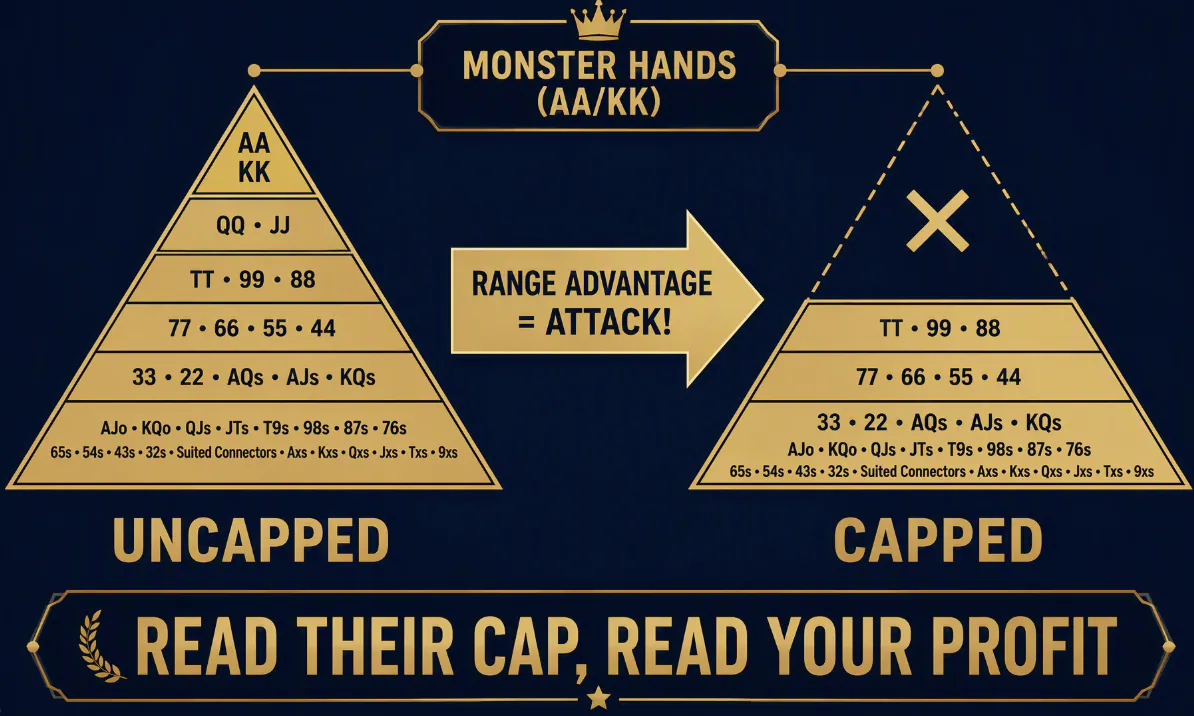
A capped range is one where the strongest hands have been filtered out by the opponent's actions. When their range is capped and yours isn't, you can value bet thinner, bluff more credibly, and go bigger with your sizing. Don't just learn to attack a cap, though. Learn to avoid capping yourself: mix in board coverage, don't value-own yourself with non-nut hands, and always have a raise plan before you bet.
Your Opponent Called Instead of Raising. They Just Handed You Something
Here's the setup. You raise preflop, the flop comes Q-9-4, you c-bet, and the button just calls. That call looks harmless. It isn't. Buried inside it is a message most players never hear: their range just got capped.
The logic is simple. With hands like AA, KK, or a set of queens, most players either raise preflop or raise the flop to build the pot. The moment they choose to just call, the monsters are largely gone from their range. What's left? Second pair, top pair with a decent kicker, draws. Strong hands, gone. And your range? Still intact. AA, KK, sets, everything. You keep all of it.
That gap is what this article is about. A capped range is information. Once you learn to read it, your bluffs get sharper, your value bets get thinner, and your win rate stops depending on what cards you were dealt.
A Capped Range Is Your License to Attack
Once the opponent caps their range, the whole hand tilts in your direction. Three things get easier at once.
Your value bets get more efficient. Hands you'd normally check for pot control, like top pair with a good kicker, suddenly become thin-value candidates. You know the ceiling of their range, so you know exactly how thin you can go.
Your bluffs get more credible. They can't hold the nuts. That means your big bets tell a story they cannot contradict. When you fire large on a scary river, they have to fold everything that isn't close to the top of what they can have, which is a low bar.
Your sizing gets an upgrade. Standard bets keep the opponent comfortable. Against a capped range, comfort is the last thing you want to give them. Overbets and large river bets, the sizes that make people genuinely miserable, are now available because they can never punish you with a check-raise from the nuts.
Put those together and something shifts. You're not reacting to the hand anymore. You're dictating it.
Why the Capped Player Can't Win
Think about it from their side. They're sitting there with a range whose best hand is something like top pair, and you're applying maximum pressure. What are their options?
Call too much, and they bleed money paying off your value hands, which include all the monsters they no longer have. Fold too much, and your bluffs print money. There's no comfortable defense frequency available to them, because the hands that could fight back, the sets and two pairs and overpairs, were filtered out two streets ago.
That's why this concept matters so much in practice. It's not a rare, exotic spot. Every flat call on the flop, every checked-back turn from a player who would bet their monsters, every "just call" where a raise was available: these are caps being set in real time, at every table, every session. Most players never notice. The ones who do get to attack for free.
Don't Cap Yourself: Three Protective Habits
Reading someone else's cap is the fun half. The other half is making sure you never hand this weapon to a thinking opponent.
Build board coverage. If your range only ever connects with high cards, certain boards expose you completely. Say you open a tight range and the flop comes 7-6-5. Your opponent knows you have nothing. Mix in hands like 76s and 87s from early position sometimes, not because they're profitable opens in a vacuum, but because they give you coverage on the boards that would otherwise leave you defenseless.
Don't value-own yourself with non-nut hands. If you're never comfortable facing a raise with a hand, think twice before betting it for value. The classic mistake is betting the bottom of two pair on a wet board, then folding to any aggression. Your bet just announced exactly where your range ends.
Have a raise plan before you bet. Before every bet, ask one question: what do I do if they raise? If the honest answer is "I have no idea," check. A bet with no continuation plan is how players cap themselves without noticing.
Turning Reads Into Money
The concept pays when you convert it into specific plays. Here's the highest-value one: the big river bet against a capped range.
The opponent flatted preflop, called the flop, called the turn. Their range has been capped three times. The river comes, and your top pair with a good kicker, a hand you might normally check back, is now effectively the nuts relative to what they can hold. Bet big. They will call with their second-best hands because humans can't fold pairs, and they can never raise you because their range contains nothing worth raising.
Before you pull the trigger in these spots, run through four questions:
- Where exactly is the cap on their range?
- What evidence supports that read?
- What's their most likely holding right now?
- What's the most profitable size against that holding?
- Do this drill for a few sessions and it becomes automatic. You'll start seeing caps everywhere, because they were always there. You just weren't looking.
Final Thoughts
Capped ranges are one of those ideas that quietly change how you see the game. Every "just call" is a confession. Every checked street from a would-be aggressor is a boundary being drawn.
Read the information. Make the decision. Collect the profit.