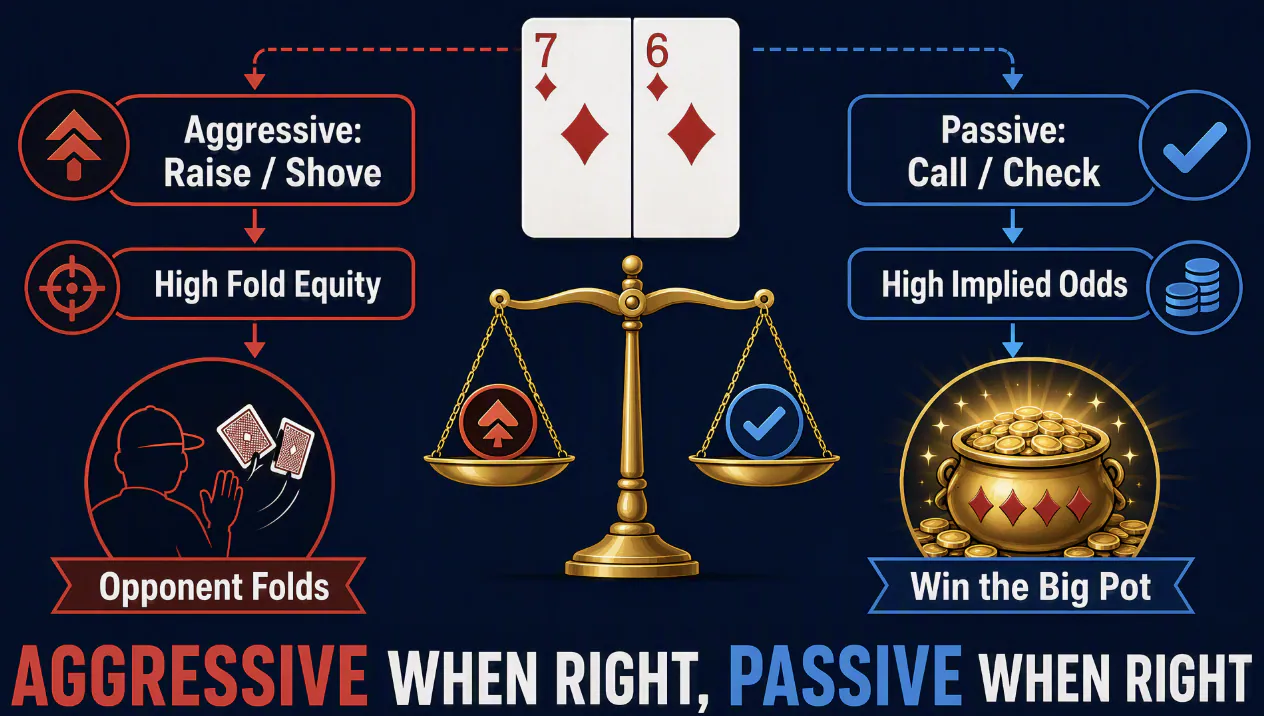
Fold equity and implied odds sit on opposite ends of a seesaw — when one is high, the other is low. The stronger your opponent's range and the less he folds, the more passive you should be, because his strong hands are your implied profit. The weaker he is and the more he folds, the more aggressive you should be, raising and taking pots down now. Bets and raises aren't courage, and calls and checks aren't weakness. The right play always depends on the opponent and the situation.
In poker circles, aggression gets hyped to the sky. The first lesson drilled into every beginner is "don't limp, don't call station-like" — as if passive play were for rookies only. Tight-aggressive ABC became the standard curriculum, and the benefits of checking and calling postflop quietly stopped being taught.
Time to make up that lesson: when is passive actually the better choice?
Let me break it down with a real coaching hand. The main character is one of my students, and his problem was textbook: too much betting, too much raising, the constant feeling that "not betting means being scared." Here's how this one hand turned that around.
First, Two Concepts: Implied Pot Odds vs Fold Equity
These two sit on a seesaw. One end goes up, the other goes down.
Implied pot odds: after you call, if you hit your hand, how much more money can you win later.
Fold equity: after you bet or raise, how likely your opponent is to fold.
Remember one sentence: when fold equity is high, implied odds are low; when implied odds are high, fold equity is low. That inverse relationship is the core code that decides whether you should play aggressive or passive.
Two Extreme Scenarios Make It Obvious
Scenario A: high fold equity, low implied odds.
You hold a flush draw on the turn, board 8♠4♠2♣3♣, your hand K♠J♠. Your opponent is a tight-weak type, extremely cautious. You raise and he'll probably fold — your fold equity is sky high.
But flip it around: even if you call and make your flush, how much is he going to pay you? He's so timid that one bet sends him running. There's nothing to squeeze. Implied odds are terrible.
Don't dawdle here. Raise and take the pot now. Most of the time you won't make your hand anyway, and the river will bring you nothing — better to close shop right now.
Scenario B: low fold equity, high implied odds.
Same turn, same kind of draw. But this time your opponent is a tilted maniac whose head is full of "I'm coming for you." You raise? He couldn't care less. Your fold equity is basically zero.
The good news: when you do hit, he keeps betting, he calls your raises, he might even stack off with you. The implied odds are gorgeous.
Here, just call honestly. Don't raise, don't spook him — let him build the pot for you.
Condensed Into Two Sentences
The stronger your opponent's range, the higher your implied odds and the lower your fold equity — play more passive.
The weaker your opponent's range, the higher your fold equity and the lower your implied odds — play more aggressive.
A small pocket pair in the big blind against a strong range is the classic high-implied-odds spot: calling is profitable, while 3-betting is just donating, because the early-position raiser is never folding to you.
Now, My Student's Hand
Blinds $0.10/$0.25. My student holds 7♦6♦ in the lojack and raises to $0.75. The hijack re-raises to $1.50. The student calls.
Preflop we already noticed something: this HJ player isn't very good. Why? A competent player doesn't give you such a cheap re-raise price. And a weak player's 3-bet range here is usually strong: AQ or better, JJ or better.
What does that mean? High implied odds, low fold equity. Hold that conclusion — it matters later.
The Flop: Why That Raise Is a Mistake
The flop comes A♦6♣3♦, pot $3.35. My student checks, the opponent bets $1.50, and my student raises to $5.
How do you rate that play?
His reasoning: "I wanted to push JJ-KK out of his range."
The idea itself isn't wrong, but I asked him one question: doesn't calling achieve the same thing — and achieve it more safely on later streets?
If you just call here and your opponent checks the turn, you've received a piece of extremely valuable information: he probably doesn't have an ace. That information is free, or close to it. Then you can bluff the river — far safer and far more effective than jamming it in on the flop.
Why? His preflop range is strong, he bet the flop, so his range is still hard. And he's a weak player; weak players never fold top pair on this board. You want to raise top pair off its hand? Dream on.
Now look at the implied odds side. You're holding a flush draw plus bottom pair: nine diamonds, plus two sixes and two sevens as backdoor outs. When you get there against a weak player's strong range, you get paid the maximum. That's the charm of high implied odds.
So the flop raise was a mistake.
The Turn: You've Shoved, But You Could Have Stopped
Then it gets more interesting. The opponent called the raise. The turn is the Q♥, the pot has grown, and my student rips a 1.4x pot semi-bluff all-in. The opponent thinks it over and folds ace-king without an ace.
The student felt pretty slick about it. I told him one thing:
"Even though you raised the flop, that doesn't mean you have to keep going on the turn. There was still time to stop."
He asked: "If I check the turn, what do I do when he bets?"
Depends. If he bets small, you call — the implied odds are good enough, you collect when the river hits and accept it when it doesn't. If he checks, even better: he's scared, and you can lead the river with total confidence, with top pair likely to pay you.
"What if he bets big on the turn?"
Then you fold. That's roughly the same EV as your semi-bluff shove — maybe even better, because you haven't strapped the entire pot to your back.
The conclusion is simple: from start to finish in this hand, the passive line beats the aggressive one.
Not every hand needs to be won by force. Sometimes you call calmly and let your opponent make the mistakes himself. That beats any fancy raise.
Three Sentences to Wrap Up
When fold equity is high, raise decisively and steal the pot; when implied odds are high, call patiently and wait for your card.
The stronger your opponent and the less he folds, the more passive you should be. His strong hands are your implied profit.
Bets and raises are not a badge of courage, and calls and checks are not a badge of weakness. The correct play always depends on the opponent and the situation.
Don't let your ego choose your plays. Be fierce when it's time to be fierce, and meek when it's time to be meek. The player who switches freely between the two is the hardest one at the table to deal with.