When opponents play loose, here’s how to squeeze them:
Bet big against the passive ones, set traps for the aggressive ones.
TL;DR – Loose players have one big weakness: they love to put money in the pot with the second‑best hand. That’s what we call reverse implied odds. Against loose‑passive players, bet as much as they’ll call when you have a strong hand – even shove the flop if you have to. Against loose‑aggressive players, just call with your strong hands, let them fire three barrels, then check‑raise the river and reel them in.

At the low stakes I play, most loose players are loose‑passive, not loose‑aggressive. Those tables are full of recreational players, and I get it – their main reason for playing is to have fun, and playing tight just isn’t that exciting.
But playing loose has a big downside: their range is, on average, way weaker than a tight player’s. In the early stages of a deep‑stack tournament, that tendency creates huge problems for them.
That habit of “throwing chips into the pot with the second‑best hand” even has a name: reverse implied odds. Implied odds are about how much you can win if you stay in the hand. Reverse implied odds are about how much you stand to lose if you keep playing.
As tighter, more disciplined players, our job is simple: figure out which kind of loose player we’re up against, and then squeeze every last drop of those reverse implied odds out of them.
Against loose‑passive players: bet big, even shove
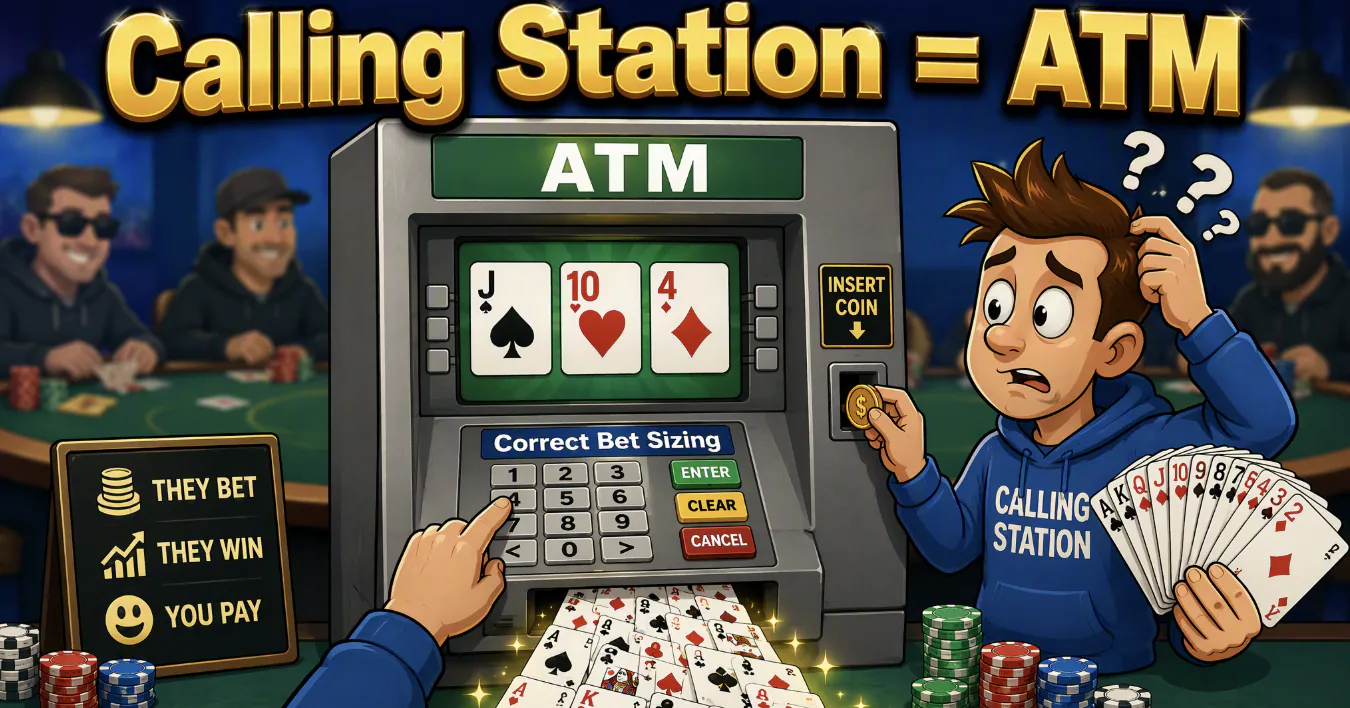
When we’ve got a strong hand and we know a loose‑passive player has something he’s willing to call with, we bet the maximum he’ll pay.
Here’s an example. I’m in an online tournament with 100BB effective stacks. A loose‑passive player opens from middle position, and I call from the big blind with T♠9♠. The flop comes T♥9♥5♣ – I hit top two pair.
If I check, he’ll bet about half‑pot, and I can make a normal‑sized raise that I expect to get called by all kinds of pairs – even bottom pair – plus all draws, including gutshots.
But if he bets closer to a full pot, I might just shove over the top right there. That bet size tells me he probably has a hand he wants to protect from draws. In my experience, players like this will call a shove with JJ and bigger pocket pairs, AT, all flush draws, and open‑ended straight draws.
Why this doesn’t work against GTO players – don’t bother trying this on GTO types. They can fold big hands. They refuse to give you those reverse implied odds. But when your opponents are calling stations in spots like this, you’re getting maximum value by shoving, and your long‑term results will actually be better than a GTO bot’s.
One more reason to shove early: a normal‑sized raise leaves room for a turn card that kills your action. If their draw misses on the turn, or if it hits and their made hand shrinks, they won’t pay you off anymore. Since their big flop bet already told you they’re willing to make a big calling mistake with their whole stack, take the money now – don’t wait.
Against loose‑aggressive players: just call, let them fire three barrels
Against loose‑aggressive players, you flip the script. When we’ve got a strong hand and we know they’re betting with a weak hand, we call – we don’t raise. Raising just lets them off the hook.
Same spot: 100BB effective, online tournament. This time it’s a loose‑aggressive player opening from middle position. Everyone folds, I call from the BB with T♠9♠, flop comes T♥9♥5♣.
If I check, he bets about half‑pot, and I just call. He’s loose, so his range doesn’t have many hands that can call a raise. He’s aggressive, so if I set the trap, he’ll keep firing with all his weak hands.
Don’t raise even if the turn looks scary.
Say the turn is 8♣ – the board gets really ugly. A typical player might raise to protect their hand. The LAG knows that. So when you just call his turn bet, he’ll put you on at best one pair on the river, assume you can’t call a big bet, and fire again on fifth street.
Against these triple‑barrel junkies, resist the urge to raise with your strong hand before the river. Letting them go one more street down the wrong path is way more valuable than showing your strength too early.
On the river: spring the trap with the best bluff‑catcher.
In this example, our T9 happens to be the perfect bluff‑catcher. It blocks a lot of value hands that beat us, like TT and 99, and it also blocks some thin value hands that might make him check back the river, like JT and J9. So when he bets the river, he’s either bluffing or holding a “value” hand that our two‑pair beats.
On the river, unless the board is so scary that even AT might hesitate to call, I’ll check, and when he bets, I shove. Even loose‑aggressive players, after putting that many chips in, will sometimes talk themselves into calling with a weak hand – even though I’m almost never bluffing in that spot.
That’s the second way to squeeze those reverse implied odds: the passive way – you take it with big bets. The aggressive way – you take it with traps, interest included.
Loose players come in two flavors. Knowing whether you’re up against the passive kind or the aggressive kind is the key to squeezing them.
Next time you sit down, take a few orbits to watch: if he just calls and never bets, charge him admission. If he’s loose and loves to fire, dig him a hole. This concept isn’t hard to understand – the hard part is remembering to use it once you’re at the table.