First, Why Do We Even Like Suited Connectors?
Quick refresher: suited connectors are hands like 6♠7♠ or J♥T♥ — consecutive cards, same suit. Their real value isn't high-card strength; it's that they can flop monsters and monster draws: straights, flushes, combo draws. When they hit, they hit hard — and they crack big pairs that refuse to fold.
But here's the catch: they miss most of the time. Which means how you play them preflop — whether you can see flops cheaply, whether you can pick up pots without showdown — matters enormously.
Most players don't lose money because suited connectors are bad. They lose money because they play them the same way in every situation. Let's break down the five most common leaks.
Mistake 1: Never 3-Betting Them
When deep-stacked opponents open and you're sitting on 100bb+, calling with suited connectors is fine. But when stacks get shallower — roughly 60bb or less — you should start leaning toward 3-bet or fold, with a preference for the 3-bet.
Why? Because calling sets up a terrible dynamic:
- You call, the big blind wakes up with a squeeze, and now you're squeezed between two players in a bloated pot. Yuck.
- Shallow stacks crush your implied odds. These hands make their money stacking people — that's hard to do when there's nothing left to win.
- A 3-bet lets you win the pot right there preflop. And when you get called, you still have a hand with real post-flop playability.
- That said, 3-betting suited connectors is technically a bluff — you don't have the best hand right now. And a bluff needs fold equity to work. Which brings us straight to mistake number two.
Mistake 2: 3-Betting Calling Stations
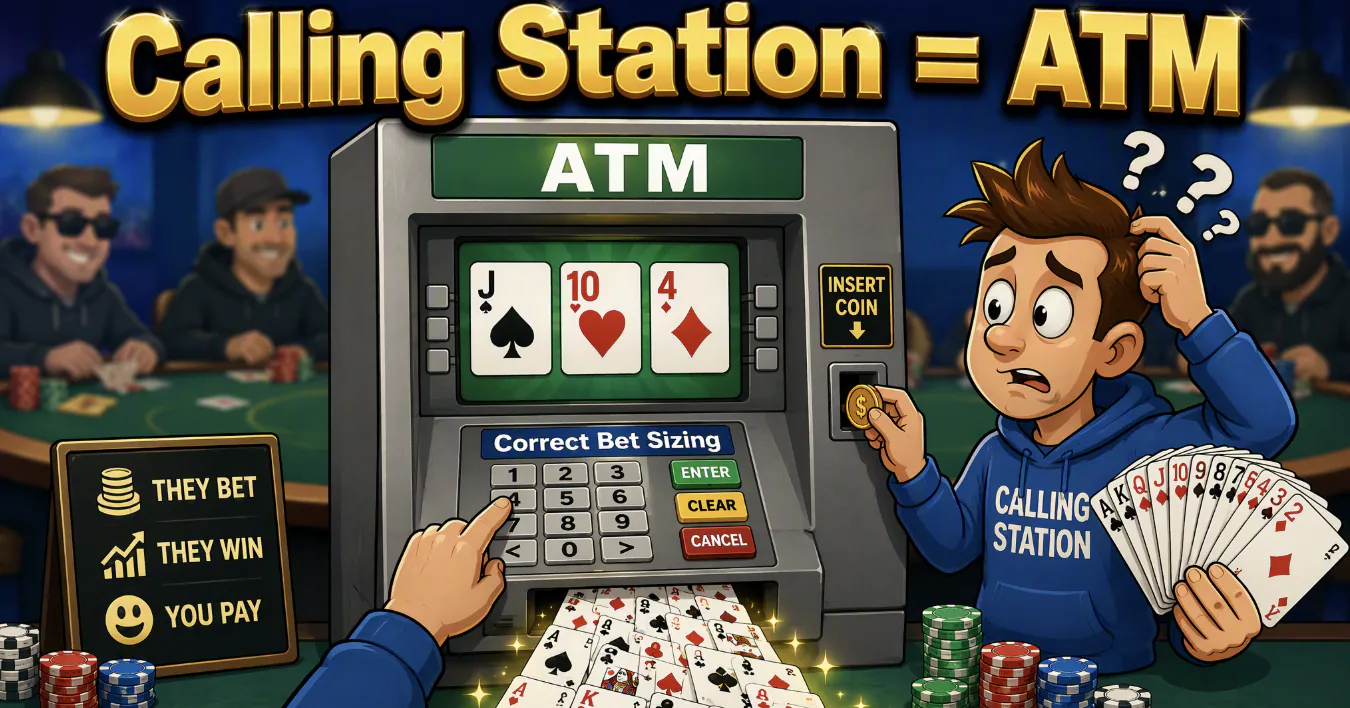
A calling station is a player who hates folding preflop. You raise, they call. You 3-bet, they call. They just want to see a flop, period.
Against these players, 3-bet bluffing with suited connectors is a disaster. Your bluff succeeds when they fold — and folding is the one thing they refuse to do. You'll constantly end up in inflated pots with seven-high, and when you finally flop a draw, they won't pay you off anyway because they're busy calling with second pair... okay, fine, sometimes they pay you off with second pair. But that's not a business model.
The fix is boring but profitable: against calling stations, play straightforwardly. Flat call with your suited connectors at a cheap price, and save your 3-bets for hands that actually dominate them — big pairs, big aces. Punish them with value, not with bluffs.
One exception worth noting: against very tight players who also play fit-or-fold post-flop, 3-betting with Ace-high or King-high suited hands (A5s, K8s type stuff) is often better than 3-betting 56s. Those hands have decent equity even when called, plus the Ace/King blocker makes their continuing range narrower.
Mistake 3: 4-Betting Suited Connectors
You've probably seen some training video where a solver 4-bet bluffs with A5s, and thought: "Cool, I'll 4-bet my 78s too."
Don't. The reason solvers pick A5s for 4-bet bluffs is the blocker: when you hold an Ace, it's significantly harder for your opponent to have AA or AK. Your 78s blocks... what, exactly? 77? 88? Those hands were probably folding anyway.
Holding small suited connectors, your opponent's realistic continuing range — AA, KK, QQ, AK — is completely unblocked. So when you 4-bet, you're not bluffing with the right ingredients; you're just volunteering to get 5-bet jammed on.
The practical rule: facing a 3-bet with suited connectors, call in position if the price is reasonable, fold out of position. Leave 4-bet bluffs to hands with an Ace or King blocker.
Mistake 4: Overcalling in Multiway Pots
A player opens, another calls, and you're on the button with 6♦5♦. "Nice hand, cheap price, let's see a flop!" Right?
Wrong — and this is one of the most widespread leaks in live poker.
Overcalling looks harmless, but it chains you into several bad outcomes:
- The blinds can squeeze, and you'll either fold (torching your investment) or call into a horrible spot.
- Even without a squeeze, you're playing a multiway pot with a hand that flops a lot of medium-strength junk — a flush draw that's not the nuts, a straight draw someone else dominates. Reverse implied odds city.
- When several players see the flop, your bluffs post-flop have to get through multiple people. Good luck with that.
- There's exactly one spot where overcalling suited connectors is fine: the big blind. You're getting a discount, you close the action (nobody can squeeze you from behind), and the pot odds are usually great. Everywhere else, prefer to 3-bet or fold.
Mistake 5: Calling Short Stacks' 3-Bets
This one comes down to cold math, so let's do it.
Suited connectors are classic implied odds hands: you invest a little now hoping to win a lot later when you smash the flop. The key variable is how much "a lot later" actually is — i.e., the effective stack.
Say the blinds are $1/$2 and you open to $5 with 7♠6♠. An opponent 3-bets to $15, so you need to call $10 more.
- If the effective stack is $100: when you hit, you can potentially win the remaining $85. You're risking $10 to win up to $85+ — that's roughly 8-to-1 or better implied odds, and with the extra bluffing and semi-bluffing routes available post-flop, the call makes sense. Deeper stacks (200bb+) push this into 16-to-1 or 20-to-1 territory, which is where these hands truly thrive.
- If the effective stack is $50: you can only win $35 more. You're risking $10 for a max of $35 — barely 3.5-to-1 — and you'll flop a strong enough hand or draw maybe a third of the time. The math just doesn't add up. Even at best-case assumptions you're looking at maybe 7.5-to-1 against a 10-to-1+ requirement.
- The rule of thumb: calling a 3-bet with suited connectors wants roughly 15-to-1 or better implied odds. Against short stacks, that number is unreachable — so fold, and don't let the pretty cards talk you into a bad call.
Quick Reference: Suited Connectors Cheat Sheet
表格
| Spot | Default Play | Core Reason |
|---|---|---|
| Deep stack (100bb+) vs open | Call (or mix in 3-bets) | Implied odds are alive |
| Shallow stack (<60bb) vs open | 3-bet or fold | Calling gets squeezed; implied odds shrink |
| vs calling station | Flat call, 3-bet only for value | Bluffs don't fold out stations |
| Facing a 3-bet | Call in position, fold out of position | Never 4-bet — no blockers |
| Open + caller in front of you | 3-bet or fold (big blind can overcall) | Multiway squeeze risk + reverse implied odds |
| Facing a short stack's 3-bet | Fold | Implied odds math fails |
FAQ
Q1: Are suited connectors good hands?
A: They're good speculative hands, not good made hands. They profit by hitting big post-flop, so they're only worth playing when stacks are deep enough to pay you off and the price is right.
Q2: Should I ever 4-bet bluff with suited connectors?
A: No. Their blockers are terrible — you don't block AA/KK/AK, which is the entire continuing range. Use hands with an Ace blocker (like A5s) for 4-bet bluffs instead.
Q3: Can I overcall with suited connectors from the big blind?
A: Yes. The big blind gets a discount and closes the action, so there's no squeeze risk from behind. It's the one seat where overcalling these hands is standard.
Q4: How deep do I need to be to call a 3-bet with suited connectors?
A: You want implied odds of roughly 15-to-1 or better — meaning the effective stack should be at least 15 times what you need to call. Short stacks make the math impossible.
The Bottom Line
Suited connectors look sexy, but they're not automatic winners — they're tools. Their value lives in specific conditions: deep stacks, heads-up pots, fold equity, and position. Strip those conditions away, and 7♠6♠ is just seven-high with dreams.
Fix these five leaks — start 3-betting shallower stacks, stop bluffing stations, never 4-bet them, quit overcalling, and refuse short-stack 3-bets — and these pretty little hands will finally start paying you instead of the other way around.
Play the conditions, not the cards.