If every seat at a poker table were occupied by a professional who understood ranges, frequencies, and bet sizing, the most reliable long-term winner would probably be the house collecting the rake.
Poker games survive because many people play for entertainment. They come in after work, enjoy seeing flops, chase the occasional draw, and remember the rush of winning a large pot. We usually call them recreational players.
Experienced players often hear that label and immediately think “weak, predictable, profitable.” There is some truth in that, but the attitude can become expensive. Recreational players do not always follow the logic you are used to. They call with hands you would never put in a standard range and occasionally attack spots where you expect almost no bluffs. You sit down believing your fundamentals give you an automatic edge, then spend the next hour wondering what just happened.
The useful response is not contempt. It is observation. Recreational players usually have patterns; those patterns simply do not come from a textbook. Find the pattern, make the right adjustment, and the edge becomes real.
Adjustment One: Look for repeated behavior before assigning a label
Many recreational players have one tendency that appears again and again. One player wants to see every flop and calls almost automatically. Another uses aggression to solve every problem. A third enters pots with decent starting hands but gives up quickly whenever the flop misses him.
Those tendencies are valuable, but one strange showdown does not make someone a maniac or a calling station. A single hand tells you what he did once. Repeated behavior tells you how he is likely to play again.
When I watch an unfamiliar opponent, I begin with a few practical questions. Does he prefer calling or raising before the flop? Does his sizing change with hand strength? Does he surrender after skipping a continuation bet? What does he reveal after making a large river bet? Showdowns are especially useful because they connect an action to a real hand instead of a story you invented for him.
Online, tracking data can reveal tendencies faster when the poker room permits such tools. Sample size still matters. A very high VPIP over fifteen hands may simply mean the player received several playable hands. The same pattern over hundreds of hands deserves much more confidence. Live, you have no statistical dashboard, so remember the hands people show and the sizes they chose along the way.
A label should remain a working hypothesis, not a permanent verdict. The important question is not “What kind of fish is he?” It is “In which situations does he repeatedly make the same mistake?”
Adjustment Two: Keep your fundamentals, then attack the specific leak
Once you identify a tendency, do not throw away your entire strategy. Start from a sound baseline and move away from it for a clear reason. Balance is your safety net; exploitation creates the additional profit. The stronger your evidence, the further you can adjust. With limited information, stay disciplined.
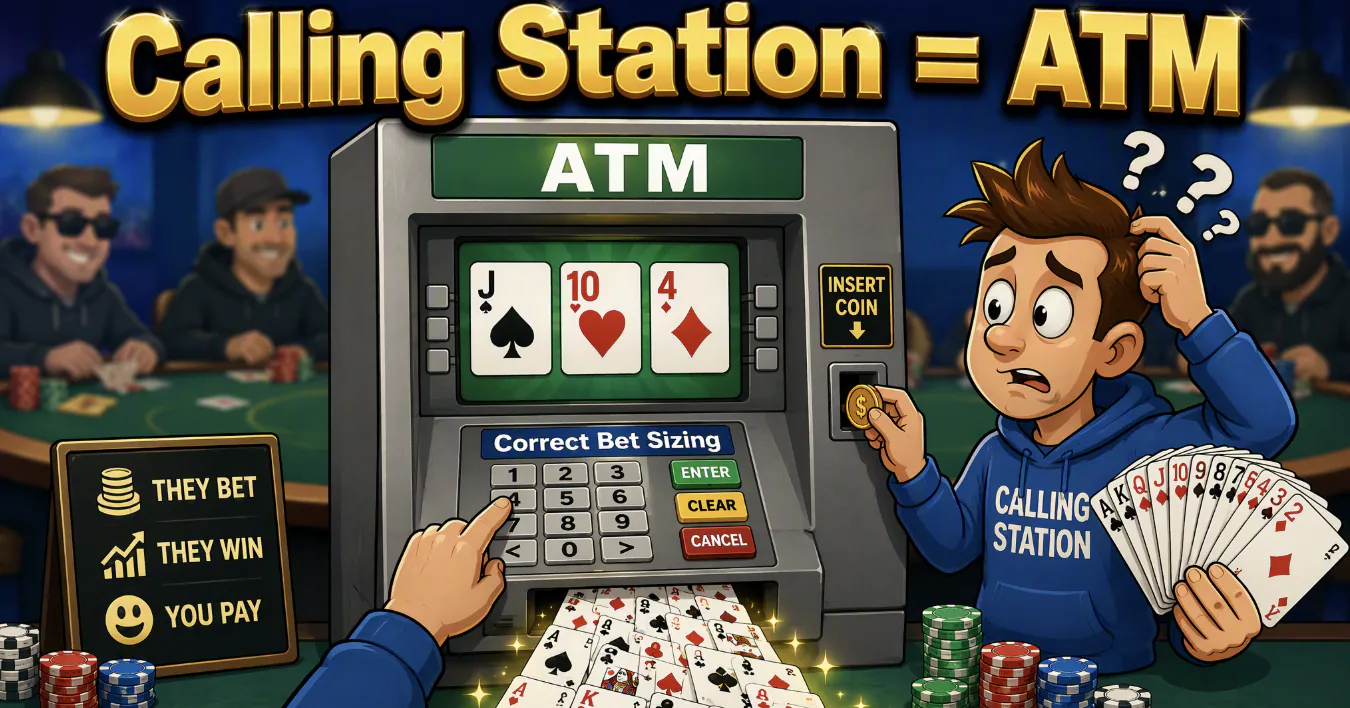
Against a calling station, reduce bluffs that lack meaningful equity and widen your value-betting range. If he calls with weak pairs, pocket pairs, and sometimes ace-high, you should not wait for the nuts before betting. Hands that would be thin value against a competent opponent can often bet three streets against someone who hates folding.
You can also choose larger sizes, provided worse hands will actually pay them. Do not assume that every calling station will call any amount on every street. Some players are extremely sticky on the flop and turn but become honest on the river. Others barely notice the sizing because they simply want to see your cards. Knowing which player you face matters more than memorizing “bet big against calling stations.”
Against a loose-aggressive player, two mistakes are common. The first is fighting for pride, turning marginal hands into huge pots just to prove you cannot be pushed around. The second is becoming so intimidated that you continue only with the nuts.
A better plan is to let him retain his bluffs while you defend a wider but still coherent value range, especially in position. Remove some unnecessary bluffs of your own, keep strong hands and appropriate bluff-catchers in your range, and give him room to keep firing. Preflop, you can make clearer value 3-bets with hands that lead his continuing range. That does not mean every medium pair should become an unlimited stack-off simply because the opponent is aggressive.
Against an extremely tight player, much of your profit comes from small pots nobody contests. Steal the blinds more often, continuation-bet favorable textures, and add delayed bluffs after he shows weakness on the turn. Floating works best when you have position, backdoor equity, or useful blockers—not when you are holding two dead cards and hoping he becomes frightened.
When a normally passive, tight player suddenly applies heavy pressure in a spot where he rarely does so, respect the information. Exploitation does not mean stealing every pot from a nit or assuming nobody ever adjusts. It means using observed tendencies to make your bets, calls, and folds more precise than a default strategy would be.
Adjustment Three: After a bad beat, manage the next decision
Bad beats happen more often when you play against very wide ranges. That is not a flaw in the game. It is part of how the edge gets paid.
When an opponent chases a draw without the right price, he will usually pay for the mistake and occasionally get there. If you want him to make the incorrect call, you must accept that he will sometimes win the entire pot. You cannot collect the long-term value of his mistake while refusing the short-term variance that comes with it.
The river card is rarely what does the most damage. The next ten hands are. Some players speed up, force marginal hands, or start a personal revenge match. Others lecture the winner: “How could you call with that?” A single lost pot becomes a losing session because frustration takes control.
Do not coach recreational players at the table, and do not ridicule their choices. There is no upside. A relaxed, friendly game also gives everyone a reason to keep enjoying the table. Your opponent can play for entertainment while you concentrate on making sound long-term decisions. Those goals do not conflict.
After a bad beat, I prefer to ask three questions. Was my range ahead when the money went in? Did my sizing make worse hands pay an incorrect price? Would I take the same line if the situation occurred again? If all three answers are yes, the hand did its job. Who received the pot is a short-term result.
The real edge comes from adjustment, not superiority
Recreational players are not one uniform category, and they are certainly not cash machines waiting for a withdrawal. Some call too much, some attack too often, and others play so cautiously that they surrender too many pots. Your job is not to prove that you understand poker better. It is to find the tendency that keeps repeating and respond in the simplest profitable way.
Value-bet more against players who call too often. Preserve sensible bluff-catchers against players who attack too much. Expand your stealing range against players who fold excessively. Stay close to your baseline when the evidence is weak, and deviate decisively when the evidence is strong. If you get outdrawn, play the next hand without complaint or revenge.
The most consistent winner at the table is rarely the player who is best at mocking mistakes. It is the player who recognizes them, exploits them, and keeps making good decisions when the cards temporarily refuse to cooperate.