“You can never go too far wrong by playing tight.”
That may be the most repeated—and most misused—piece of advice in poker.
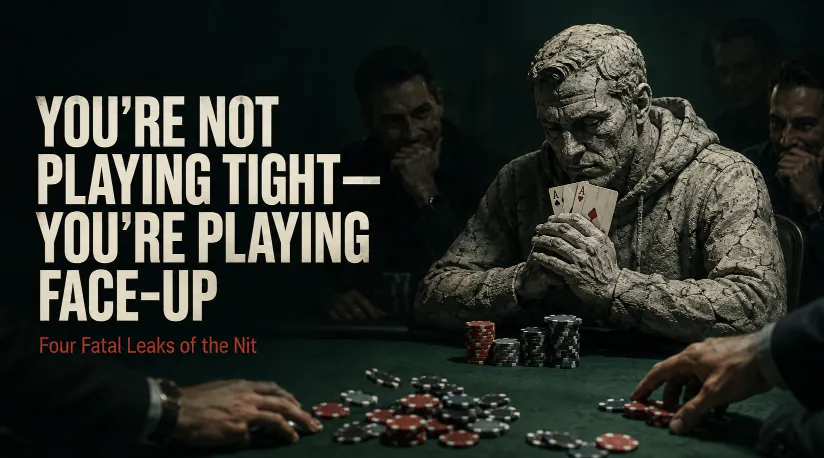
I have seen plenty of players take it to the extreme. Preflop, they wait for AA, KK, QQ, and AK, perhaps adding JJ when they are feeling adventurous. Postflop, they refuse to put real money in without at least top pair. The moment they face a raise, the same thought appears: “Am I already beat?” A few seconds later, their cards slide into the muck.
At the table, we call this player a nit.
Nits rarely make spectacular mistakes. They sit quietly, occasionally turn over aces, collect a modest pot, and return to waiting. They may avoid losing many huge pots, but they rarely win many either.
Let us make one distinction clear: tight is not the problem; passive and predictable is.A strong tight-aggressive player starts with a disciplined range, then fights for pots, protects that range, and absorbs pressure when the situation calls for it. A tight-passive player only completes the first step: waiting for a hand. Once the hand arrives, he often has no idea how to extract its full value.
If that sounds uncomfortably familiar, these are the four leaks you need to examine.
1. Your frequencies are giving your hand away
Every poker action has a frequency: how often you open, continuation-bet, call, raise, and fold under pressure. One isolated decision may look perfectly reasonable. Over dozens or hundreds of hands, those decisions form a very clear picture.
Suppose you open only 77+ and AJ+ from middle position. However you count the exact combinations, that is a narrow, recognizable range. Most of the time the action reaches you, you still fold. When you finally enter a pot, everyone knows you are unlikely to be light.
That creates an awkward bargain. When you have a premium hand, nobody wants to pay you. When the board becomes complicated, your opponents know you are unlikely to withstand much pressure.
Say you open AA, the big blind calls, and the flop comes J♠-9♥-8♣. You c-bet and face a check-raise. Is it uncomfortable? Of course. Two pair, sets, and several strong draws are available, and pocket aces are no longer a hand you can stack off with blindly.
But “I cannot stack off automatically” is not the same as “I must fold to the raise.” If you continue only with two pair or better on boards like this, too much of your betting range collapses at the first sign of resistance. An observant opponent does not need a monster every time. Once he sees you overfold, he can add more semi-bluffs—and eventually pure bluffs.
The nit says, “I only folded hands that were behind.”
The opponent sees something else: this player gives up whenever I push back.
You think you are controlling risk. In reality, you are offering the table a way to profit without ever showing a hand.
2. You become the easiest target at the table
The most attractive opponent is not always the loosest one. Often, it is the one whose reactions are easiest to predict.
The tight-passive pattern is hard to miss: entering a pot means strength, continuing means even more strength, and showing weakness means genuine surrender. Nobody needs a sophisticated read when your actions have already written the answer across your face.
So opponents begin to adjust:
You c-bet the flop; they raise you more often.
You check the turn; they widen their betting range.
You look unwilling to play a large pot on the river; they choose a bigger size and apply maximum pressure.
You can justify every fold: “He never bluffs this spot.” “That sizing is always value.” “My hand is only a bluff-catcher.” In one particular hand, you may be completely right. The problem is that if this is always your conclusion, your opponents no longer need to have anything.
You might tell yourself, “My game is soft. Nobody is paying that much attention.”
Do not lean too heavily on that assumption. Many live players cannot explain range advantage or minimum defense frequency, but they are excellent at remembering one simple fact: that guy folds when you raise him.They may not know the theory, but they will still bluff you more often.
Assuming your opponents are not watching is one of poker's most expensive forms of self-deception.
3. You keep replacing evidence with stories
Most nits are not born cautious. A few painful pots teach them to become that way.
I went through the same phase. Early on, I stacked off with KK on the flop and ran into a set. Hands like that stay with you. The next time I held an overpair and faced heavy resistance, an alarm went off in my head: “It is a set again. Get out.”
After this happens a few times, a subtle habit develops: fold first, then build a convincing story to explain the fold.
“He cannot be bluffing here.”
“He has at least two pair.”
“When this type of player bets big, he always has it.”
The main purpose of these stories is often not to read the opponent accurately. It is to make you feel better after folding.
Poker is not an excuse to call recklessly “for information.” Expensive hero calls can burn an entire night's profit. But if you never bluff-catch in a sensible spot, never reach showdown, and never review ranges afterward, your assumptions never get calibrated.
Useful information comes from verification. Will this opponent raise a draw on this texture? Does that river size contain missed draws? Will he bet one pair for three streets when stacks are deep? You do not have to pay for the answer every time. But when the price, your blockers, and the opponent all line up, you must occasionally allow yourself to look him up.
Otherwise, you are not reading hands. You are repeatedly obeying fear.
4. The value you surrender exceeds the chips you protect
The nit's deepest fear is losing a large pot. So he enters with the narrowest range, chooses the safest line, and escapes any uncomfortable situation as quickly as possible.
That approach does prevent some ugly losses. The cost is equally real: it removes the opportunities that create long-term profit.
Poker is not a contest to see who can lose the least. Profit comes from making a few more correct decisions than your opponents: winning one more undefended pot, finding one more thin value bet, applying pressure when a range is capped, or making one uncomfortable but correct call against someone who bluffs too much.
If you wait only for AA, KK, QQ, and AK, the table will adapt. Opponents will pay you less when you are strong and take more pots when you show weakness. Eventually, your entire “winning strategy” becomes this: wait for aces and hope somebody else happens to hold a hand they cannot fold.
That is not strategy. It is a lottery ticket.
Reliable profit comes from thin value, well-chosen bluffs, accurate bluff-catches, and player-specific adjustments. None of those skills appears by magic. You have to enter marginal situations before you can learn to navigate them.
The way forward: you do not need to become a maniac
This is not an attack on tight players. Almost everyone who takes poker seriously passes through a stage of thinking, “I would rather win less than make a mistake.” I certainly did.
But understand the tradeoff: nitty poker may help you lose less; it rarely helps you win big.
Improving does not mean suddenly blasting away with any two cards. Start by becoming tight-aggressive. Keep your disciplined preflop selection, but play more actively after the flop. Stop treating every raise as an automatic fold. Add bluffs when you hold the right blockers. Make thin value bets when worse hands can call. Against opponents who fire too often, be prepared to catch them with the right bluff-catchers.
Most importantly, stop confusing comfort with correctness. Good poker decisions are often uncomfortable because they require you to accept calculated risk with incomplete information.
Tight is a discipline. Weak is a habit.
Keep the first. Break the second.