You're on the button with 8♥7♥. You raise preflop, the big blind calls. The flop comes J♥6♥2♠. He checks.
You want to c-bet. Then the question hits you: how much? One-third pot? Half? Two-thirds?
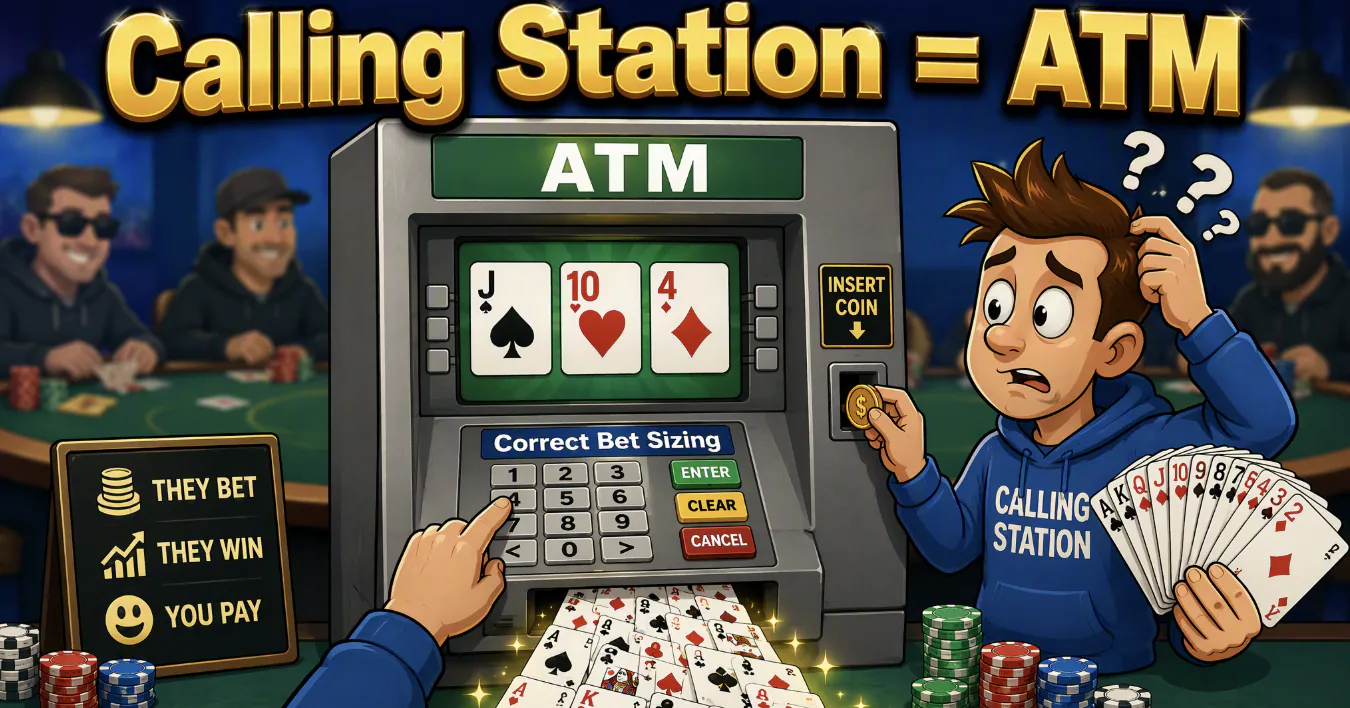
A lot of players never think it through. They have one default — half pot, every flop, every board, no matter what they hold or what the flop looks like. On the surface that looks "balanced." In reality it's just leaving money on the table.
Bet sizing isn't something you feel your way into. There's a logic chain behind it. Once you understand it, the sizing decision stops being a guess.
1. What Sizing Is Actually For
Forget the solver charts for a second. At its core, a bet does three things:
First, it builds the pot. When you have a strong hand, you want more money going in. Big bets grow the pot exponentially across three streets.
Second, it prices your opponent. When you're betting a draw or protecting a vulnerable hand, you don't want to give him a cheap look at the next card. Make him pay to chase.
Third, it defines his range. A small bet keeps a wide range in — his weak pairs, floats and backdoor draws all continue. A big bet squeezes that range down to real hands.
Small bet, wide continuing range. Big bet, narrow continuing range. Keep that one sentence in your head and most sizing questions answer themselves.
2. What Counts as Small, What Counts as Big
Before we go further, let's define terms. Streets play by different rules, so the benchmarks shift:
On the flop:
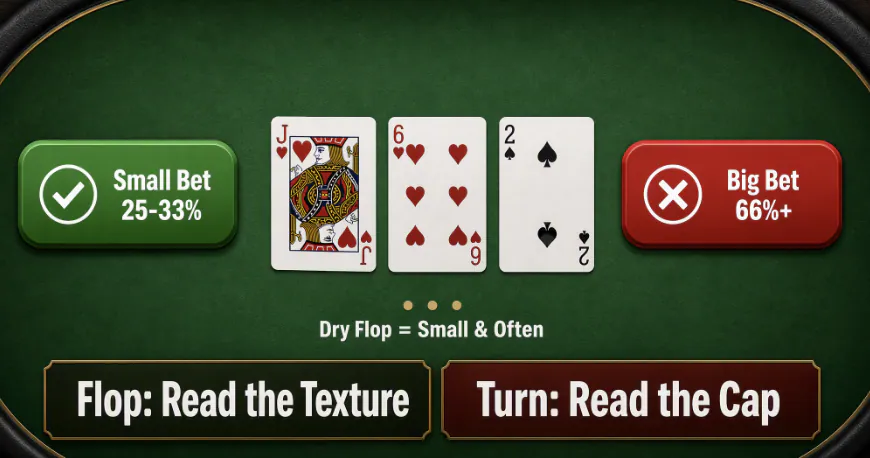
- Small bet: 25%–33% of the pot
- Big bet: 66% of the pot or more
- On the turn and river:
- Small bet: 66%–75% of the pot
- Big bet: 90% of the pot or more, including overbets
- Notice something: a "small bet" on the turn is bigger than a "big bet" on the flop, in percentage terms. That's not a typo. The streets have different jobs, and we'll get to why.
3. Flop Sizing: Two Golden Rules
Rule one: the drier the board, the smaller you bet — and the more often
A dry board is something like K♠7♦2♣ or A♥9♣3♦. Almost no draws, very few hands connected to it, and the nuts on this flop will still be the nuts on most turns.
On boards like this, your opponent either has something or he has nothing. When he has nothing, your bet size barely matters — he's folding to 25% pot just the same as he'd fold to 75%. So why pay more for the same fold?
And when he does have something — say top pair on that K-7-2 flop — he's not folding to a big bet anyway, but he'll happily call a small one. Meanwhile your small bet also forces his junk to put money in with hands that have almost no equity. Every time he calls with 5♠4♠ on K♠7♦2♣, you print a little.
There's a bonus: small bets let you bet your entire range at high frequency. Every air hand in your range gets a cheap bluffing price. That's why on dry flops, solvers c-bet nearly 100% of the time — at 25–33% pot.
Rule two: the wetter the board, the bigger you bet — and the less often
A wet board is something like J♥T♥8♠ or 9♣8♣7♦. Draws everywhere, two-pair combos everywhere, and the nuts on the flop can be second-best by the turn.
On these boards you can't bet your whole range anymore. Too many of your hands hate this flop, and betting everything into an opponent who connects with it constantly is burning money. So you bet less often — but when you do bet, you bet big.
Why big? Two reasons. Your strong hands need to charge the sea of draws before they get there. And your bluffs need real fold equity, because on a wet board your opponent has plenty of honest hands that aren't folding to a tap.
There's one more hidden reason: your checking range needs protection. If you only ever bet big with your monsters, the hands you check are face-up as weak, and your opponent will attack every check. Betting big at lower frequency keeps him guessing about both ranges.
A note from the solver world
Solvers lean the opposite way from most humans, and it's worth knowing. Left to their own devices, solvers use small bets relatively more often with weak hands and big bets relatively more often with strong hands — and overall they prefer smaller sizes.
Does that mean you should copy it? Not blindly. A solver's opponent is another solver — perfectly balanced, impossible to exploit. Your opponents aren't. If you're up against a calling station who never folds a pair, stop bluffing small and start value betting big. If you're up against a nit who folds everything, bet small with your whole range and collect. Theory gives you the default. Your reads give you the adjustment.
4. Turn and River: One Question Decides Everything
Later streets run on a different question. Before you pick a size on the turn or river, ask yourself:
Is my opponent's range capped?
A capped range means his actions have removed the strongest hands from his range. Say he just called your flop bet on K♠7♦2♣ and the turn is a 4♥ — he almost certainly doesn't have K-K or 7-7, because most players raise those on the flop or earlier. His range is "capped" at one pair of kings. Yours isn't: you can still have every set, every overpair, every big hand.
When his range is capped, that's your green light to bet big — 90% pot, 100% pot, or an overbet. He can't punish you, because he never has the hands that want to raise. Your value hands get maximum value, and your bluffs get maximum pressure.
When his range isn't capped — when he can still hold the nuts — slow down and use the standard 66–80% pot. Overbetting into an uncapped range is asking to get raised at the worst possible moment.
If you're not sure how to spot a capped range in real time, that's a skill of its own — worth studying separately. The short version: every time your opponent just calls on a street where the strongest hands would raise, his range gets a little more capped.
5. Why Small Bets Almost Disappear on the Turn and River
Remember the benchmarks: on later streets, even a "small" bet is 66–75% pot. Why did the little 25% stab vanish?
Because on the turn and river, a small bet has exactly one job: thin value. You're holding a medium-strength hand, you want to get called by worse, and you want him to fold his bluff-catchers that actually beat you. That's it. That's the whole use case.
The problem is that most medium hands don't even want that job. On later streets, your medium-strength hands usually prefer to check and play the bluff-catcher role themselves — let him bet his missed draws into you, then call. That's a far more comfortable way to realize their value than betting and praying you don't get raised.
So by the turn and river, your betting range has polarized: strong hands betting for value, bluffs betting for folds. Both of those want money in the pot — and both want a big size. The small bet gets squeezed out.
6. Back to the Opening Hand
Let's bring this home. You're on the button with 8♥7♥, the flop is J♥6♥2♠, and the big blind has checked to you.
Run the checklist. Is this board dry or wet? Bone dry. There's a flush draw, but no straight draws to speak of, and the jack is the only card anyone's likely to be proud of.
Dry board → small bet, high frequency. Bet 25–33% of the pot — and do it with basically your entire range, not just this flush draw.
Why is this perfect for your actual hand? If he has nothing, he folds and you take it down for the minimum price. If he calls, you're getting money in with a draw that has huge equity. And if he raises, you have a comfortable decision — your draw is strong enough to continue.
Notice we never once asked "how strong is my hand?" On the flop, the board decides the size. Your hand mostly decides whether you're happy about it.
7. Three Quick Tests
Let's see if the logic stuck. Three spots, three answers.
Question 1. You raised preflop, one caller, flop comes A♥9♣3♦. What's your default?
A) Bet small
B) Bet big
Answer: A. This is a textbook dry flop — no draws, and the ace heavily favors the preflop raiser's range. Bet small with your entire range. There's nothing to protect against, and small bets extract from his weak pairs and floats while bluffing at the cheapest price.
Question 2. The flop is J♣8♦4♥. You c-bet small, he calls. The turn is the 2♠ — a total brick. Now what?
A) Bet small
B) Bet big or overbet
Answer: B. When he just called your flop bet, he capped his range — he would have raised sets, two pair and most overpairs. The deuce changes nothing, so he's still sitting there with one-pair hands at best, while you still have every overpair and set in your range. His range is capped, yours isn't. Time to apply maximum pressure.
Question 3. The flop is Q♣9♦4♥. You c-bet small, he calls. The turn is the J♠. Now what?
A) Bet the standard size
B) Overbet
Answer: A. Careful — the jack is not a brick. Hands like K-T and T-8 just got there, and J-9 made two pair, and all of those are hands he'd naturally call the flop with. His range is not capped; he can absolutely have the nuts now. Overbetting here runs into real hands far too often. Stick with the standard 66–80%.
8. Theory Is a Map, Not a Cage
Everything above is the theoretical default — what you'd do against an opponent who plays perfectly and never makes a mistake. You will never meet that opponent.
Real players leak. Some never fold a pair, any pair, to any size — against them, cut the bluffs and hammer every value hand for the maximum they'll pay. Some fold everything short of top pair — against them, fire small bets with your entire range on every street until they push back. Some treat a small bet as weakness and raise it every time — now your small bets with monsters become traps.
The theory tells you what's "normal." Your edge comes from spotting how this specific opponent deviates from normal, and twisting the sizing dial to punish it. A default you never adjust is just a habit. A default you adjust on purpose is a weapon.