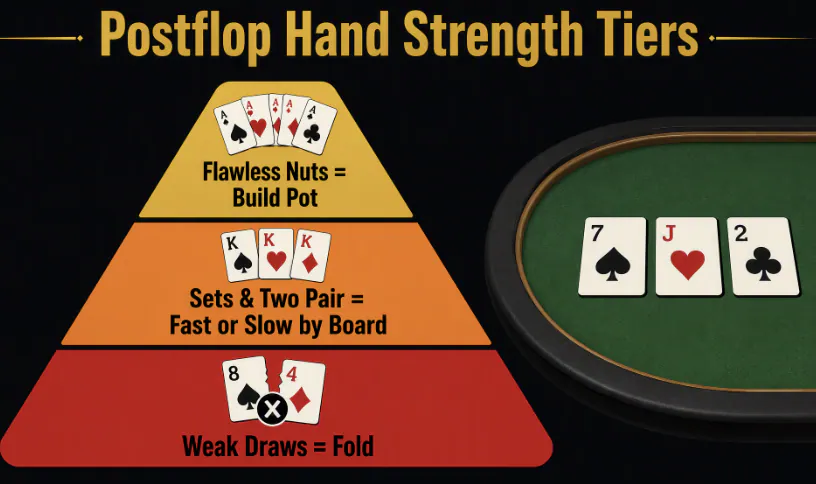
Once the flop lands, which tier your hand belongs to decides how you play it. This framework sorts postflop hands into 18 levels, from flawless monsters down to weak draws. Strong hands build pots, wet boards demand protection, dry boards invite traps, and weak hands hit the muck.
Every Postflop Mistake Starts With Misreading Your Tier
The flop comes out, and how strong your hand is determines how you should play it.
That's not a platitude. Most postflop mistakes share one root cause: the player doesn't know which tier their hand actually belongs to. They charge when they should slow down, hesitate when they should charge, and hang on when they should let go.
This article gives you a complete postflop framework, broken down tier by tier from strongest to weakest. After reading it, you'll know exactly where any hand stands.
Tier 1: Flawless Monsters
Quads, the nut full house, the nut flush, the nut straight. These hands have no weakness. They can't lose to anything in their own category.
The strategy fits in one line: whatever gets the money in, do that.
If nobody takes the lead, build the pot yourself. Betting 30%-50% of the pot is usually enough — give the chasers a price that looks affordable so they stick around.
The key is not betting so big that everyone runs. You want calls, you want raises, you even want bluffs. Leave some room, and the fish will bite.
Tier 2: Strong but Flawed Hands
Small full houses, non-nut flushes, non-nut straights. Strong hands, but with a ceiling — run into a bigger flush or a higher straight and you're done.
Two routes.
Route one: go hard on the flop and raise repeatedly. Since your hand has a flaw, don't give anyone a free card to chase. Be ready to back it with your whole stack and end things fast.
Route two: slow-play to the turn. If the flop situation is unclear, wait one street. If the turn is a safe card — one that helps no draw — that's your moment to strike.
But watch out: if the turn brings the fourth flush card or completes the straight, your hand may no longer be strong. Don't cling to it. When it's time to let go, let go.
Tier 3: Three of a Kind (a Set From Your Pocket Pair)
How you play a set depends on board texture.
Wet board (two to a flush or two connected cards): attack immediately, and attack hard. Betting 200%-300% of the pot is fine — price the chasers out. Almost any turn card makes the board more dangerous. And even if you're already behind a straight or flush, you still have about a 34% chance to improve to a full house by the river. Those odds are worth fighting for.
Dry board (few draws available): slow down. Check or call small, and let them walk into it. Anyone holding top pair or better will build the pot for you.
Tier 4: Top Two Pair, or Top Pair Plus Bottom Pair
Similar to sets, but a notch more cautious.
Dry board: slow-play. Bet small or call, and collect value on later streets.
Wet board: punish the chasers. In a multiway pot, big bets are fine. If your kicker is an ace, make the players chasing with AK or AQ pay for it.
Tier 5: Bottom Two Pair
This hand looks strong. It's actually fragile — too many turn cards can pass you.
Protection is the core. Bet, raise, and drive the chasers out.
Say you made two pair with a connector like 98s on a K-9-8 flop. A huge number of turn cards will give you a headache: any K, Q, J, T, 7, or 5 complicates the board. And if the turn pairs the board without improving you to a full house, be extra careful — someone may already have passed you with a bigger two pair or a set.
Tier 6: Overpairs
Big overpairs (AA, KK): you can slow-play. Use calls or small bets to induce raises. But remember — never let more than one or two opponents see the flop.
Medium overpairs (JJ on a T-9-7 board): completely different story. Take the pot down on the flop, because any high card on the turn can beat you. Be especially careful on boards like 9-8-7, T-9-8, J-T-9 — with a flush draw out there and an opponent betting or raising, you're probably already behind.
Tier 7: Top Pair, Top Kicker (TPTK)
Most of the time you should bet, and keep betting through the turn. Plenty of weak opponents will call you with worse kickers.
But the board matters:
Dry board (K-7-3 rainbow): slow-playing is fine.
Wet board (K-J-9 with a flush draw): you must bet big on the flop to protect your hand. Almost any turn card can let opponents catch up.
Say you hold AT on a T-7-2 flop. Either take it down right there, or make the players holding 89, T9, JT, QT, KT pay to chase. Any 6, J, Q, or K on the turn can complicate your life.
Tier 8: Top Pair, Weak Kicker
In an unraised pot, if your hand is likely ahead, make a normal bet and take it.
But with four or more opponents, consider folding.
If a tight player bets pot-sized, your weak kicker is almost certainly beaten — fold. If there are still players left to act behind you, be even more careful.
The only exception: your hand carries serious added value. Say you hold 89s and the flop comes 6♠-7♠-8♦. It's only top pair with a weak kicker, but you have around 20 outs against AA — that hand is worth playing for your whole stack.
Tier 9: Middle Pair
The classic choice is fold or bet.
In position, against two opponents at most, when everyone checks to you — bet and take the pot. Weak players will call with middle pairs or draws; tight players might even fold a better top pair.
If a strong opponent bets into you, especially with players still to act behind you — fold.
If your bet gets called, you should give up on most turns too. The only exception is when you're sure the opponent is weak and aggressive — then a call or raise to see the turn is reasonable.
Tier 10: Middle Pair With an Ace Kicker
Depending on the table and the opponents, either lead out or check-fold.
In the last seat, with everyone checking to you — a bet is worth considering.
But don't go deep. You played Ax suited to make two pair, trips, or the nut flush. A lone middle pair with an ace isn't worth much.
Tier 11: Middle Pair, Weak Kicker
In a two- or three-way pot: check-fold, or use position to bet when everyone checks to you.
Sometimes you can take a free card on the check and hope to make two pair on the turn. If anyone bets, fold.
Tier 12: Bottom Pair
Check-fold. Or, with only two or three players and everyone checking to you, use position to bet and steal.
Occasionally you can take a free card and peek at the turn, but don't hope for much. Anyone bets, you're gone.
Tier 13: Bottom Pair With an Ace Kicker
Always fold. You have at most 5 outs (3 to make two pair, 2 to make trips), and the ace kicker might even help an opponent make a bigger two pair.
If you do decide to bet, it's a pure bluff — only consider it with few opponents, good position, and no face cards on the flop.
Tier 14: Bottom Pair, Weak Kicker
Always fold. Don't get cute from late position either. It's not worth it.
Tier 15: Strong Draws
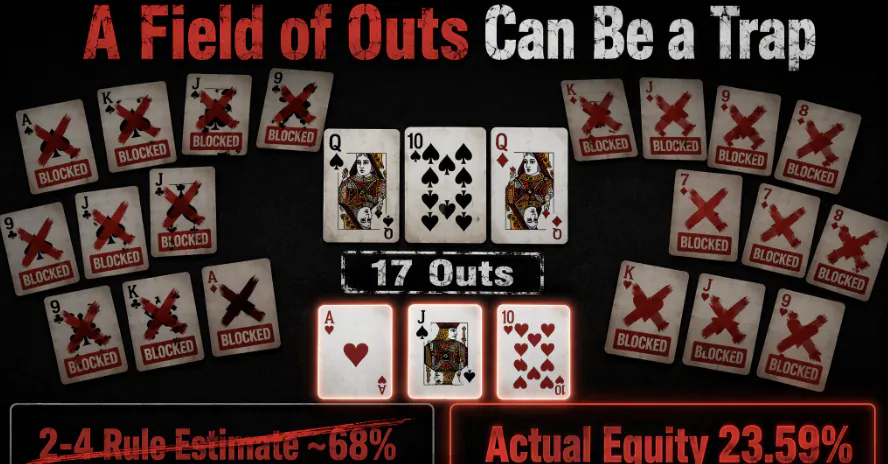
Nine outs or more: ace-high flush draws, two overcards plus a straight draw, combo draws.
Don't call. Always consider betting, raising, or check-raising. Apply pressure.
Heads-up or against two opponents, with 12 outs or more (9 flush outs plus 3 ace-high top-pair outs), your chance of hitting by the river is about 50%. Shove the flop, and even if you get called you're +EV.
Later positions favor these hands — you get to react to the action in front of you. Short-stacked with a decent pot? Just shove.
Remember: the point of a draw is to make the best hand. Make sure you're not drawing dead against the nuts.
Tier 16: Non-Nut Draws
Nine outs or more, but not to the nuts.
Be ready to fold these, especially in raised multiway pots. You don't want to chase all the way, make the second-best hand, and lose your whole stack.
Most of the time, avoid investing much in non-nut flush or straight draws. Flush draws especially — you'll run into the ace-high flush often enough to regret it.
In an unraised pot, you can take a stab with a big bet. But never call and chase.
Tier 17: Weak Draws
Eight outs or fewer, not to the nuts.
Don't chase. The pot odds aren't there, and you may well be drawing dead — hit and still lose.
Best approach: see the turn as cheaply as possible, then act if you hit. Base the bet, raise, or fold decision on the table, the opponent, and your position. Don't waste money calling.
Tier 18: Overcards (AK, AQ, KQs, AJs)
These hands demand extra caution, against strong and weak opponents alike.
Strong players know that you, as a tight player, often hold overcards when the flop comes all low. That gives them a license to bluff you.
If the flop has no face cards (A, K, Q, J), you can bet 70%-80% of the pot as a semi-bluff, representing an overpair.
But don't build a bad habit: when the flop is all low cards, the table is crowded, and flush or straight possibilities are out there, don't fire away with overcards. You're just burning money and bluff credibility.
Remember: with only one or two opponents and an irrelevant flop, your overcards may still be the best hand — but tread carefully.
Jasper‘s Advice
Postflop play comes down to three things.
Know your tier. From flawless monsters to trash, every level has its own playbook.
Read the board. Dry or wet, safe or dangerous — that decides whether you play fast or slow.
Read your opponent. Is he chasing or trapping? Tight or loose? That information sets your bet sizing.
Keep this tier framework in your head. Next time the flop lands, there's no on-the-spot agonizing — oh, my hand is this tier, so this is how I play it.