Good Hand, Good Position, Big Pot — Reality Never Cooperates
What's the perfect script in poker? You have a great hand, a great seat, and a big pot.
Too bad reality never plays along. More often you're holding KK, the second-best starting hand in the game, while sitting in the worst seat at the table: under the gun or UTG+1.
Just like that, a premium hand becomes a problem. Play it too hard and nobody pays you. Play it too scared and you get outdrawn.
This article lays out the complete plan for KK in early position.
1. Preflop: Three Options, Three Price Tags
Holding KK in early position, you have three roads to take.
Option one: the standard raise (ABC poker)
The most standard route. Raise, take the initiative, collect information.
But there's a catch: raising from early position is like holding up a sign that says "I have a real hand." Most of the table folds and you collect the blinds. The ones who call are mostly holding speculative hands — small pairs, suited connectors. Their plan: flop big and stack you.
So the standard raise usually ends one of two ways. You win a small pot right away, or you lose a big one when someone connects. That's the fate of the early-position raise.
Option two: limp-reraise
The trap play everyone loves. Limp in, wait for someone to raise behind you, then spring the reraise.
Sounds clever? It has serious problems.
First, a limp-reraise screams strength. Anyone with experience reads it instantly: you've got AA or KK, maybe AK. Will they call your trap with QQ or JJ? Rarely. They're far more likely to just fold and leave you winning nothing.
Second, even if someone does call, the pot is already inflated, and you don't have position. You'll act first on every street — you've basically put yourself on the grill.
Finally, what if nobody raises? Now you're playing a multiway limped pot with KK, acting first after the flop, with a crowd behind you. A nightmare.
This play works in exactly two situations: your opponent is a maniac, or your table image is so bad nobody believes you anymore. Otherwise, leave it alone.
Option three: limp-call
Quieter and bolder. Limp in, someone raises, you just call. No reraise.
The upside: your hand is completely hidden. Opponents put you on a wide range and never suspect KK.
The downside is just as clear: if someone raised and only you called, you're heads-up without position — manageable. But if nobody raises, you're in a multiway limped pot with no information, no position, and all the problems.
Preflop summary: the standard raise is the steadiest, limp-reraise is the flashiest, limp-call is the sneakiest. Which one you pick depends on the opponent, your image, and the mood at the table. Just don't pick the same one every time.
2. The Flop: Three Boards, Three Fates
Once the flop lands, KK's fate is largely decided. Three scenarios.
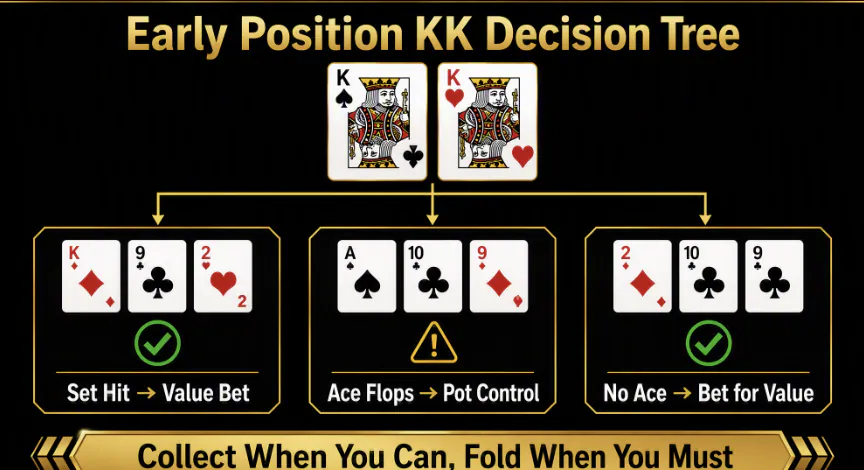
Scenario one: you flop top set (K♦9♣2♥)
Congratulations, the dream start. You're holding the nuts, and the only question is how to get the money in.
If you were the preflop raiser, bet. No slow-playing, no tricks. If the flop has a flush draw, bet even bigger. You want someone holding AK or AA to feel "I'm ahead" and go to war with you.
If you limped in, you can check-call or check-raise and let the opponent make the first move. The dream is an opponent holding AK or AA who thinks he's trapping you — when actually, you're the hunter.
One warning: if you limp-reraised, opponents will almost never pay you off — unless they flopped their own set with 99 or 22 and think you're bluffing.
Scenario two: an ace flops (A♠T♣9♦)
This is the flop KK least wants to see. Bar none.
Your kings instantly drop from "overpair" to "middle pair," and with an ace on board, anyone could have it.
If you limped in and the pot is multiway, don't be stubborn. Play your KK like a pair of tens. Don't dream about a big pot — winning a small one is already a gift. Someone bets, and without a specific reason to stay, fold.
If you were the preflop raiser, things are a bit better. The range that called you contains plenty of hands weaker than an ace: QQ, JJ, AK that missed, even KQ. You still hold the initiative and can fire a continuation bet to test the water.
But avoid the two extreme mistakes.
Mistake one: folding the moment you see the ace. The opponent hasn't shown any strength yet. What are you panicking about?
Mistake two: hammering all three streets and blowing the pot to the moon. You have one pair of kings, not a royal flush.
The correct line: bet to probe, and shut down if you meet resistance. The moment he shows any "I have an ace" signal — calling your bet, raising, leading out — start planning your exit.
And if someone bluffs you in this spot, let them have it. There's no need to make hero calls with KK.
Scenario three: you're an overpair (2♦T♣9♣)
No ace, no king on the board. You're the overpair, and most likely you have the best hand.
If you limped in, you're still ahead of most of the opponents' ranges. Bet for value — they'll call with top pairs, draws, or smaller overpairs.
If you were the preflop raiser, you're almost certainly ahead. In the opponent's range, the hands that beat you are only sets (22, TT, 99) or two pair (T9). Combined, those combos are far fewer than the losing hands he'll call you with.
So the question here isn't "what if he has a set." It's "how do I squeeze the most value out of all his losing hands."
Sure, sometimes you'll run into a set and lose a big pot. But in the long run, value betting KK on these boards wins far more than it loses.
Remember: sets are lottery tickets, top pair is everyday life. Don't give up the everyday profit to guard against the lottery.
3. Four Sentences to Remember
Preflop, the standard raise is the steadiest. Save the limp-reraise for maniacs.
Flop a set, bet for value with confidence. An ace flops, control the pot and survive.
On ace-free boards you're probably ahead. Don't let the fear of sets talk you out of betting.
KK is a hand that makes you money over the long run, not a hand you have to stack off with every time.
The hardest part of playing KK in early position isn't technique. It's mindset. You have to accept winning small pots, accept occasionally losing a big one, and never let the fear of the big loss stop you from collecting the small wins.
Bad seat, great hand — play it smart. Be fierce when it's time to be fierce, be humble when it's time to be humble. KK was never the problem. The problem is how you use it.