What Makes a Bluff a Suicide Bluff?
Some bluffs, the moment you make them, you just know. This hand is over.
We call them suicide bluffs. Not because they look aggressive, but because they're fundamentally irrational: you're risking way too much to win a pot that was never worth it.
What creates one? Three factors.
First, a terrible risk-reward ratio. Risking most of your stack to steal a tiny pot — the math simply doesn't work.
Second, the opponent's range is too strong. You're bluffing into a range full of hands that can call, and no story is good enough to change that.
Third, weak blockers. Your hand doesn't block the nuts, so you can't reduce the chance he's sitting on a monster.
The more of these factors show up, the closer your bluff is to suicide. Let's break down a real hand and watch all three turn one player's bluff into a donation.
The Setup
$2/$5 game, deep stacks, around 250BB effective.
Preflop, a loose recreational player who loves burning money opens from UTG to $4.44. A regular behind him 3-bets to $18.
The 3-bet makes sense. The regular has the fish targeted and wants to isolate him.
Everyone else folds. The rec calls. Pot: $39.
Flop: Q♥8♥3♦
The rec checks. The regular bets $16.54.
Notice the sizing — smaller than the preflop 3-bet. Interesting detail: the regular might be betting small on purpose to tilt the rec. Some recreational players get triggered by small bets. They read it as a challenge and refuse to fold.
The rec calls.
Turn: A♦
This card is great for the regular's range. His 3-bet range is stuffed with AA, AK, AQ, KK, QQ. And he has position.
For the rec, this ace should be the exit sign. The bottom of his range is dead.
But you guessed it — he didn't leave.
Why? A classic mistake: he still has chips, so he doesn't want to go.
Having chips left is not a reason to stay. If anything, calling two streets out of position just makes the river decision more painful. And more expensive.
The rec checks. The regular bets $51.3. The rec calls again.
River: K♠
Final board: Q♥8♥3♦A♦K♠.
This king is icing on the cake for the regular. His preflop 3-bet range — QQ, KK, AA, AK, AQ — all of it connected. Remember factor two, opponent range strength. The regular's range is now absurdly strong: two pair minimum, sets everywhere.
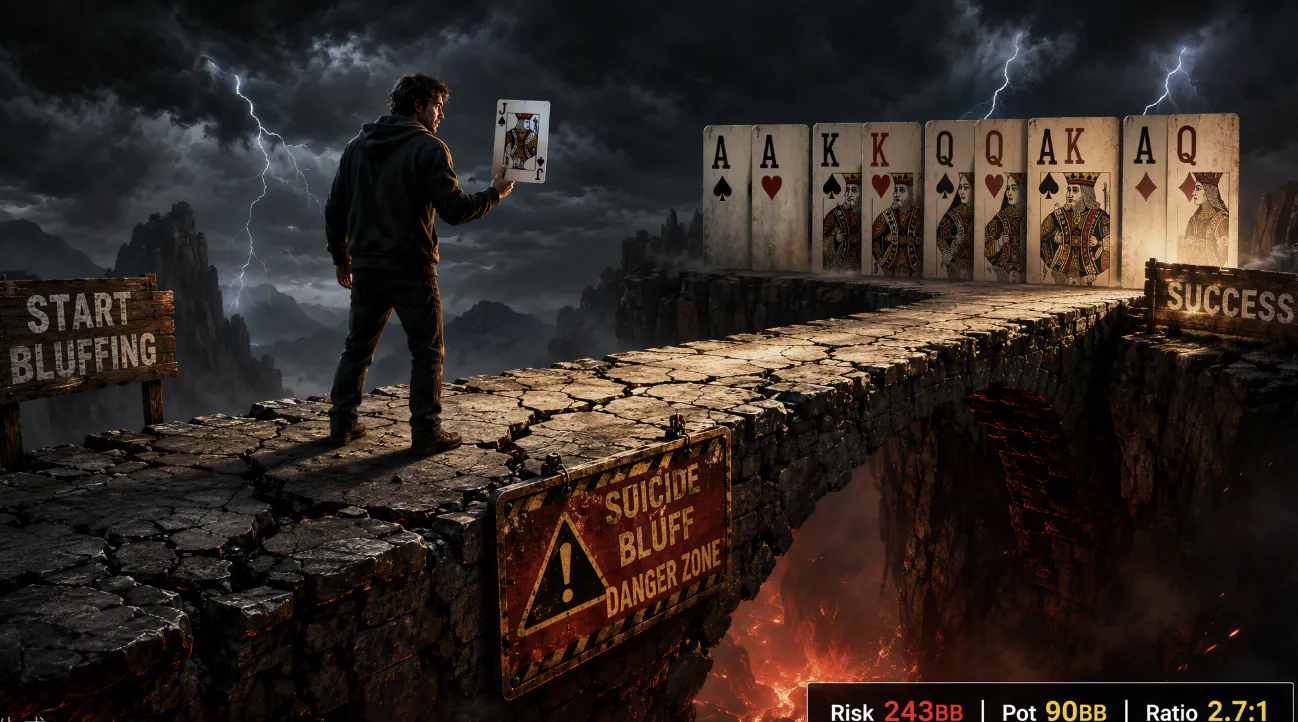
Then the rec does something jaw-dropping: he shoves $486.2, about 243BB.
To win a pot of less than $180. About 90BB.
That's factor one — a horrific risk-reward ratio. Risking 243BB to win 90BB means this shove needs to work an absurd percentage of the time to show a profit. Against a range crammed with two pairs and sets, how often is that?
Now factor three — blockers. What hand could the rec be representing? JT, the nut straight. He called a 3-bet preflop, check-called the flop, check-called the turn, then shoved when he got there. The story itself checks out.
The problem? It's just not convincing enough. Because way too many other hands in the opponent's range can call — not just JT.
The regular tanked, then called with 8♠8♦.
That's right. A set of eights.
The rec shows: J♠9♦.
Nothing. The flop gave him a gutshot. The turn left him with the same gutshot — only a ten could save him. The river missed. And he shoved.
To make it worse, his "blocker" J♠ only blocks 3 of the JT combos: J♠T♠, J♠T♥, J♠T♦. There are still 12 JT combos out there, 3 of them suited. The blocker effect is almost meaningless.
And on top of JT, the opponent's range also holds AA, KK, QQ, AK, AQ — every single one of which is snap-calling that shove.
What This Hand Teaches Us
At low stakes, bluffing logic is simple: pick on the weak, and bluff into weak ranges in small pots.
Trying to bluff a huge pot out of a strong range? That's not courage. That's a donation.
Three lessons to take with you:
Do the math — how much are you risking to win how much? If the ratio is off, don't pull the trigger.
Read the opponent — is his range strong? If it is, your acting skills won't save you.
Check your blockers — does your hand block his most likely nuts? If not, don't force the story.
Suicide bluffs look aggressive. But they're not strong. They're just dumb. A good bluff is calculated, selective, and aimed at a weak range.
Don't let your bluff become a suicide.