Let's get the definition out of the way first. A cold call is when you call a raise preflop without a single chip invested — no bet, no blind. The button calling a cutoff open is a cold call. The cutoff calling an under-the-gun open is a cold call. If you're putting money into the pot from a zero-investment position, it counts.
When an opponent does this, he's usually holding a pretty condensed batch of hands. The logic is simple: you've already announced you have something playable, so for him to call without the blind discount, he needs something with more promise than your middling stuff. In other words, he's very picky about what he enters the pot with.
And here's the problem: against a competent player, once someone cold-calls you with position, you're often in rough shape on the flop. Why? Keep reading.
First, Do the Flop Math
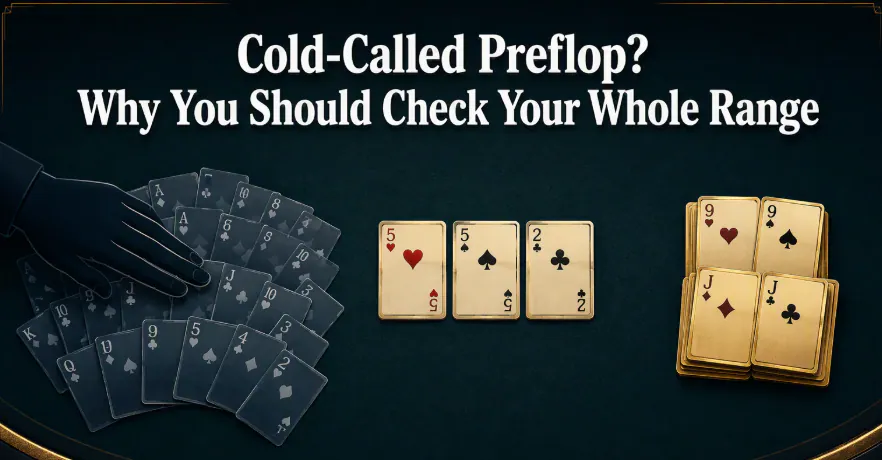
Take a standard cutoff-versus-button spot. The flop comes 5♥5♠2♣, an innocent little board. Boards like this almost never connect with either player's unpaired hole cards, but they're extremely friendly to pocket pairs.
So the question is: who shows up with a pocket pair more often?
The answer is the guy across from you — the cold caller.
Sure, you might stroll into this flop with 66 through JJ yourself. But the density of pairs in his range is far higher than in yours. As the cutoff raiser, you opened something like 25 to 30 percent of starting hands, and the pairs in your range are heavily diluted by unpaired hands. Look at the raw numbers: a big pair like QQ has exactly 6 combinations, while JT alone has 16. Add up all the unpaired hands and they come to roughly three times the pocket pairs in your range. That's how range-versus-range accounting works, and it lands you on the losing side.
Of course, you can still hold big overpairs, and he doesn't own a monopoly on good hands. The trouble is concentration: those hands make up a genuinely small share of your range, while medium pairs like 66 through TT show up in his far more often. That's a very real advantage.
When You're Behind, Raise Your Checking Frequency
Against a tough opponent, you have to learn to deploy every holding in your range as one single unit.
Think about what you do in the big blind: whether you're holding trash or the nuts, you check to the preflop raiser. That's called a procedural check, and you know the rhythm well — let the raiser act first. The logic behind it: your weak hands are protected by the strong hands that check alongside them. You check your whole range not because the raiser has some magic aura, but because your range is genuinely weaker than his.
Getting cold-called by a tight player in position is the same story in different clothes. You should likewise start by checking your whole range. What this limits is one specific thing: how much money you're forced to shovel into the pot when a weaker range collides with a stronger one.
Does Checking Everything Give Up Value?
No. At least not against opponents who are actually thinking.
On a low board in a cutoff-versus-button spot, once you check, your opponent knows perfectly well that his medium pair is probably the best hand right now, and that it badly needs protection. Hands like that have every incentive to bet at a high frequency when you check, because your range is stuffed with "big cards that missed" — exactly the air he wants to collect.
And that's precisely your opening. When you get lucky and flop trips with A5 suited, or you're sitting on a big overpair, you can turn his aggression against him: check-call, or even check-raise. If he does check back, leading out with a big turn bet and bloating the pot works perfectly fine too.
There's a bonus perk: when you check with strong hands, you sometimes coax bluffs out of holdings that would have folded to your bet. Free money. Take it.
What If He's the Overly Passive Type?
If the player across from you is excessively passive, forget balance entirely. Go straight for unbalanced exploitation: bet your value hands on the flop, and delay your bluff c-bets to later streets.
This buys you two things. With air, you get to see whether this transparent opponent likes his hand before you risk a chip. With value, your bet conveniently kills any thought he had of checking behind.
What If He Cold-Calls Too Wide?
The players who cold-call with too many hands come in two flavors: passive and aggressive. Once they widen their range that much, your "my range is the underdog" problem disappears on its own — pot control and careful c-betting suddenly matter a lot less. What matters now is how to exploit them.
Against the passive ones, the plan fits in one sentence: build pots for value. Bet big with your strong hands and your high-upside draws. On a board like K♠10♠6♥ against a gentle player, for example, fire big with 66 and QJ, and go small with weaker bluffs like AJ. It's pure exploitation, and against players who see only their own cards and the board, it works nine times out of ten.
Against the aggressive ones, checking your whole range is still the right framework. You get to reel in some seriously out-of-line bluffs, plus careless bets from medium-strength hands that genuinely good players know not to make. Same board, K♠10♠6♥: against this type, I love check-raising with 66, the bottom set. They'll end up piling two bets in on the flop with nothing but Tx, where a stronger player would have just checked back.
Wrapping Up
As the preflop raiser, it's easy to fall into a betting addiction: you raised, so you want to keep firing, as if not pulling the trigger meant leaving something on the table.
This article really comes down to two things. Against a big blind defending with a weak, wide range, don't be polite — fire away. Against the condensed range of a cold caller, checking your whole range more often is the smart play.
And remember: checking isn't waving a white flag. It doesn't weaken your ability to extract value. It saves your ammunition for the streets where it counts.